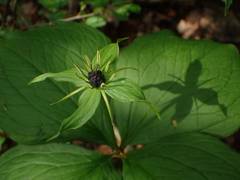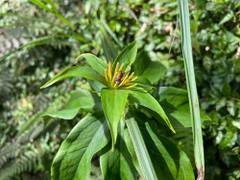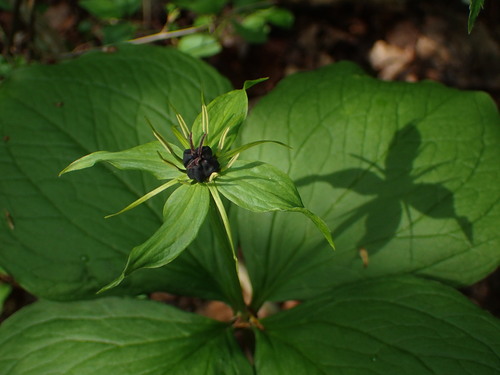
Paris, Genus, spp., Multiple species,
- Genus
- Multiple species
herb paris
Overview
Paris is a genus of about two dozen rhizomatous woodland perennials in the family Melanthiaceae, native to temperate and subtropical Eurasia. Each stem rises 8 to 36 inches (20 to 90 cm) and is topped by a single whorl of four to many oval to lance-shaped leaves. A solitary flower stands above the whorl on a short stalk, with narrow green outer sepals, thread-like or strap-shaped inner petals in green or yellow, a ring of stamens, and a central ovary that is often dark red or purple. Flowering runs from late spring into summer. The fruit is a berry-like capsule that splits or remains fleshy, holding seeds in red or black pulp. The genus spreads slowly by creeping rhizomes to form colonies on the forest floor. Paris grows in deep to part shade on cool, moist, humus-rich, well-drained soil and emerges early before the canopy closes. Plants are slow to establish from seed, which can take two years to germinate, and the rhizomes are slow to increase. All parts contain saponins and steroidal compounds that are toxic if eaten, and P. polyphylla is harvested for these compounds in traditional medicine. The whorled leaves and solitary flower give the genus a symmetrical, structured form in shade plantings.
Native Range
Paris is native to temperate and subtropical regions of Europe and Asia, from the British Isles across to China and the Himalayas. Plants grow on shaded forest floors and in moist mountain woodland on humus-rich soils.Suggested Uses
Paris is grown in shaded woodland gardens, shade borders, and among ferns and other shade perennials. The whorled foliage and solitary flowers add form to the woodland floor. It suits cool, moist, naturalistic plantings rather than open or dry sites.How to Identify
Appearance
Size & Dimensions
Height8" - 3'
Width/Spread8" - 1'6"
Bloom Information
Flowering occurs from late spring into early summer, roughly May to July, with a single long-lasting flower on each stem. The green and yellow flowers are subtle and draw flies and small insects. A berry-like capsule develops over summer and ripens in autumn.
Detailed Descriptions
Foliage Description
greenGrowing Conditions
Sun Requirements
Tolerates up to 4 hours of direct sunlight daily
• Full Sun: 6+ hours of direct sunlight
• Partial Shade: 3-6 hours of direct sunlight
• Full Shade: Less than 3 hours of direct sunlight
Care & Maintenance
Care Guide
Paris grows in deep to part shade on cool, moist, humus-rich, well-drained soil that does not dry out in summer. It emerges early in spring, so a site under deciduous trees gives light before the canopy closes. Plants establish slowly and are sensitive to disturbance once settled, spreading gradually by rhizome to form colonies. A yearly mulch of leaf mold feeds the soil and holds moisture. Seed-raised plants are slow, often taking several years to reach flowering size, so division of established clumps is the quicker route.Pruning
No pruning is required for these herbaceous plants. The single stem dies back to the rhizome in autumn and can be cleared once it yellows. Ripe capsules may be removed to collect seed or left for self-sowing.Container Growing
Suitable for container growing
Minimum container size: 2 gallons