Parietaria, Genus, judaica, Species,
- Genus & species
Pellitory-of-the-wall
Mediterranean Basin, Europe, North Africa, western Asia
Overview
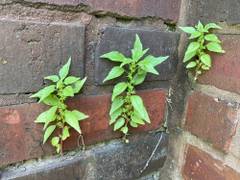
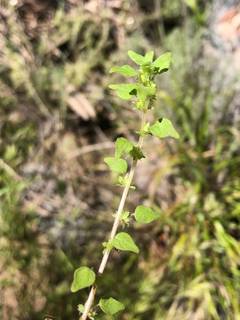
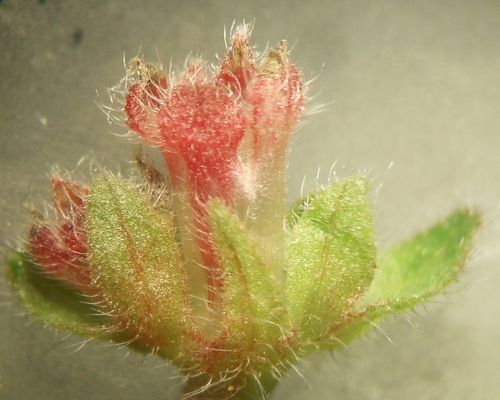
Parietaria judaica is a sprawling, short-lived perennial herb of the nettle family, forming spreading clumps 12-36 inches (30-90 cm) high and about as wide on walls, rocks, and disturbed ground. Unlike true nettles it has no stinging hairs. The reddish, brittle stems carry alternate, oval to lance-shaped leaves 0.8-2 inches (2-5 cm) long, glossy above and softly hairy beneath. Tiny greenish flowers without petals cluster in the leaf axils from May to October; they are wind-pollinated and release large amounts of pollen that is a leading cause of hay fever in Mediterranean regions. The fruit is a small, black, one-seeded achene enclosed by persistent bracts. The deep, woody rootstock resprouts after the top growth is cut or frosted, and broken root fragments regenerate readily, making established plants persistent. It roots into mortar joints, pavement cracks, and rock crevices, tolerating drought and poor soil, though it dies back in hard frost and grows in light shade in hot climates.
Native Range
Native to southern and western Europe, North Africa, and western Asia, centered on the Mediterranean Basin. It has naturalized widely in Britain, Australia, New Zealand, and parts of North and South America, often on old walls and urban sites.Suggested Uses
Rarely planted on purpose; it appears as a self-seeded colonizer of walls, rockeries, and dry stony ground. Where tolerated, it stabilizes loose rubble and crevices in informal stonework.How to Identify
Appearance
Size & Dimensions
Height1' - 3'
Width/Spread1' - 3'
Bloom Information
Detailed Descriptions
Foliage Description
greenGrowing Conditions
Sun Requirements
Requires 3-8 hours of direct sunlight daily
• Full Sun: 6+ hours of direct sunlight
• Partial Shade: 3-6 hours of direct sunlight
• Full Shade: Less than 3 hours of direct sunlight