Olearia, Genus, axillaris, Species,
- Genus & species
coastal daisy-bush
Overview
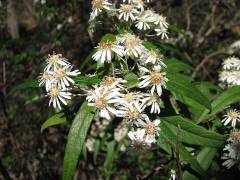
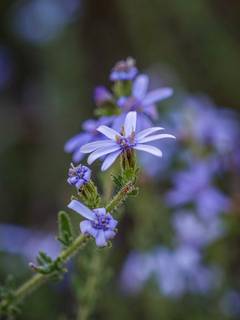
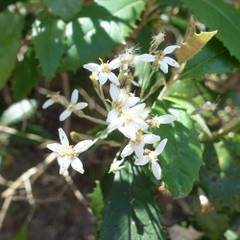
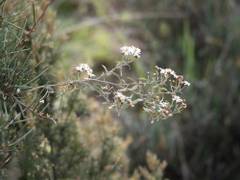
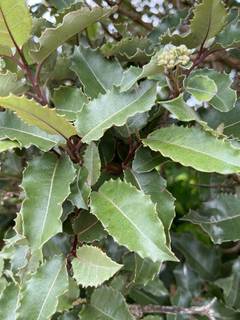
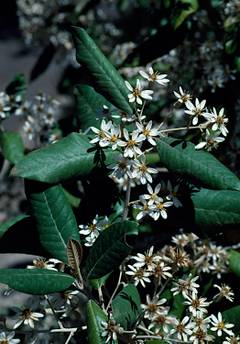
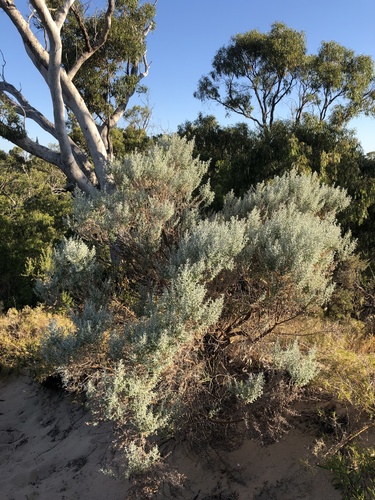
Olearia axillaris is an evergreen shrub in the daisy family reaching 2-6 feet (0.6-1.8 m) tall and 3-8 feet (0.9-2.5 m) wide, with a dense, rounded, mounding habit. Leaves are alternate or clustered, narrow and linear, 0.4-1.2 inches (1-3 cm) long, grey to silvery and covered in dense felted hairs that give the whole plant a soft grey-silver appearance, and aromatic when crushed. Small daisy flower heads about 0.2 inch (5 mm) across, cream to white with a yellowish centre and few or no obvious ray florets, appear singly in the upper leaf axils, mainly in late summer and autumn. Dry one-seeded fruit with a tuft of hairs follow and disperse on the wind. Growth is moderate to fast, with plants filling out in 2-3 years and living about 8-12 years. The species tolerates salt spray, wind, sand, and drought, but is short-lived in humid inland gardens and can open up at the base with age.
Native Range
Native to coastal southern Australia, from Western Australia across South Australia, Victoria, New South Wales, and Tasmania. Grows on coastal dunes, cliffs, and sandy foreshores in exposed, salt-laden, free-draining sites at or near sea level.Suggested Uses
Planted in coastal, seaside, and low-water gardens, on dunes and exposed banks, and as a low informal hedge, spaced 3-5 feet (0.9-1.5 m) apart. Salt and wind tolerance suit it to front-line coastal plantings and erosion control on sand. A short life in humid inland gardens limits its use away from the coast.How to Identify
Appearance
Size & Dimensions
Height2' - 6'
Width/Spread3' - 8'
Bloom Information
Detailed Descriptions
Flower Description
Cream to whiteFoliage Description
Grey to silverGrowing Conditions
Sun Requirements
Requires 6-12 hours of direct sunlight daily
• Full Sun: 6+ hours of direct sunlight
• Partial Shade: 3-6 hours of direct sunlight
• Full Shade: Less than 3 hours of direct sunlight
Care & Maintenance
Care Guide
Grows in full sun in free-draining sandy or rocky soil and tolerates salt spray, wind, and drought once established. Water through the first season; established plants need little or no summer water and rot in humid, poorly drained conditions. Trimming after flowering keeps the plant dense and slows opening at the base. The grey foliage stays dense in full sun and becomes sparse and open in shade. Few pests affect it, though root rot follows overwatering in heavy soil.Pruning
Trim lightly after flowering, taking up to one-third of the growth to keep the plant dense and rounded. Pruning into green growth reshoots, while cutting hard into bare old wood is less reliable. Regular light trimming slows the opening of the base in older plants.Pruning Schedule
Prune: May–June
fall
Container Growing
Suitable for container growing
Minimum container size: 5 gallons