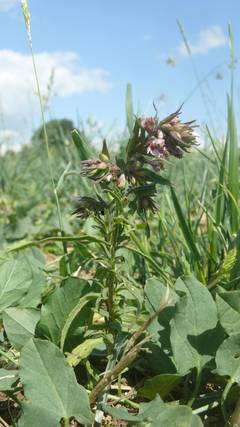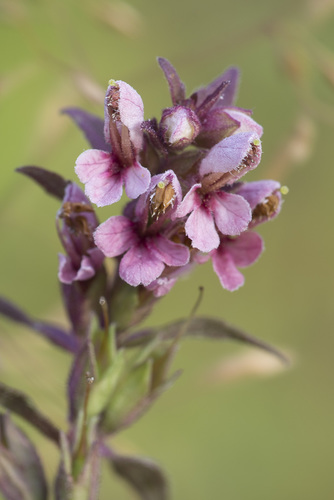
Odontites, Genus, vulgaris, Species,
- Genus & species
red odontites
SunFull Sun – Part Shade
WaterMedium
Overview
Odontites vulgaris, red bartsia, is a slender, hemiparasitic annual in the broomrape family, growing 4-20 inches (10-50 cm) tall with branched, often reddish stems clothed in short downward-pointing hairs. As a partial parasite, it makes its own food through green leaves but also taps the roots of nearby grasses for water and minerals through underground connections. The narrow, lance-shaped leaves are toothed and arranged in opposite pairs. The flowers are dull pinkish-purple, about 0.3-0.4 inch (8-10 mm) long, two-lipped, and arranged in one-sided leafy spikes that nod to one side. They open from the base of the spike upward through summer. The whole plant often takes on a dull reddish or bronze tint, especially in dry, open sites. After flowering it sets small seed capsules and dies, completing its cycle in one season. It grows in grassland, field margins, road verges, tracks, and disturbed ground, usually on heavier, damp soils. Native to Europe and temperate Asia, it is a common late-summer plant of rough grassland and a nectar source for bees.
Native Range
Native to Europe and temperate Asia, from Britain eastward across Russia, and introduced in parts of North America. It grows in meadows, grassy field margins, road verges, tracks, and disturbed ground, usually on heavier, moist soils.Suggested Uses
Used in wildflower meadow and grassland restoration, especially in schemes aimed at supporting bees, since its roots also suppress vigorous grasses and help diversify the sward. It is not grown as a border plant.How to Identify
Appearance
Size & Dimensions
Height4" - 1'8"
Width/Spread4" - 10"
Bloom Information
Flowers from midsummer to early autumn, mainly July to September, opening from the base of each one-sided spike upward. The dull purplish-pink flowers are worked steadily by bees, including specialist solitary bees. Seed capsules ripen and shed before the plant dies in autumn.
Detailed Descriptions
Foliage Description
green to reddishGrowing Conditions
Sun Requirements
Requires 5-12 hours of direct sunlight daily
• Full Sun: 6+ hours of direct sunlight
• Partial Shade: 3-6 hours of direct sunlight
• Full Shade: Less than 3 hours of direct sunlight
Water & Climate
Water Needs