Myriophyllum, Genus, spicatum, Species,
- Genus & species
Eurasian watermilfoil
Overview
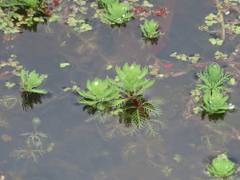
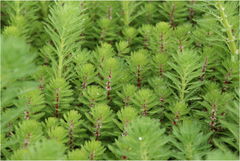
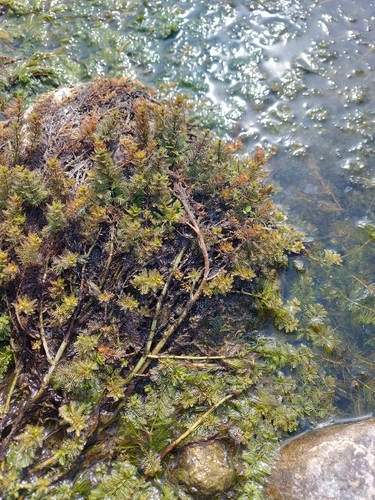
Myriophyllum spicatum is a submerged aquatic perennial in the water milfoil family (Haloragaceae) with stems reaching 1-20 feet (0.3-6 m) in length, rooted in the substrate and growing through the water column to form dense canopies at or just below the water surface. Unlike M. aquaticum (parrotfeather), M. spicatum is entirely submerged except for the small emergent flower spikes. Leaves are in whorls of 4, finely pinnately divided into 12-21 pairs of thread-like segments per leaf, olive green to reddish-brown. Stems branch profusely near the surface, creating a dense canopy that shades out native submerged vegetation. Flowers are small, reddish to yellowish, borne on emergent spikes 1-3 inches (2.5-8 cm) above the water surface. Reproduction is overwhelmingly vegetative: stem fragments as short as 1 inch (2.5 cm) with a single node regenerate. Rhizomes anchor in sediment and produce overwintering root crowns. Auto-fragmentation occurs naturally, with stems breaking at abscission points to create self-dispersing fragments. The species ranks as the most widespread aquatic invasive weed in North America by waterbody count, infesting more than 700 water bodies in Washington State alone; it is a federal priority species for aquatic invasive management. Dense canopies impede boat navigation, reduce recreational use, alter fish habitat, and lower dissolved oxygen. Hybridizes with the native M. sibiricum to produce M. spicatum, which exhibits hybrid vigor.
Native Range
Myriophyllum spicatum is native to Europe, Asia, and northern Africa, in freshwater lakes, ponds, rivers, and reservoirs from sea level to approximately 6,500 feet (2,000 m). Likely introduced to North America in the 1940s, possibly through aquarium releases or ship ballast. Infests water bodies across all 50 states and southern Canada. The species is the most widespread and economically damaging aquatic invasive weed in the Pacific Northwest by lake-acreage coverage.Suggested Uses
Used as a primary case study in aquatic invasive-species management, lake ecology, and recreational waterway impact assessment. The fragment-based dispersal mechanism and auto-fragmentation biology are taught in aquatic weed biology courses. The hybridization with native M. sibiricum is studied in invasion genetics. Boat inspection and decontamination protocols are standard components of aquatic invasive-species management curricula. Economic-impact analyses of milfoil infestations carry the species into natural-resource economics courses.How to Identify
Appearance
Size & Dimensions
Height1' - 20'
Width/Spread1' - 5'
Bloom Information
Small reddish to yellowish flowers on emergent spikes 1-3 inches (2.5-8 cm) above the water surface, borne June through August. Wind-pollinated. Seed production is variable; vegetative reproduction via fragmentation is the primary dispersal mechanism. Auto-fragmentation creates self-dispersing stem pieces. In the Pacific Northwest, peak growth and canopy formation fall in July through August.
Detailed Descriptions
Flower Description
Reddish to yellowish; small flowers on emergent spikes 1-3 inches (2.5-8 cm) above the water surface; June-AugustFoliage Description
Olive green to reddish-brown; whorled, finely pinnately divided into 12-21 pairs of thread-like segments; entirely submerged; evergreenGrowing Conditions
Sun Requirements
Requires 4-10 hours of direct sunlight daily
• Full Sun: 6+ hours of direct sunlight
• Partial Shade: 3-6 hours of direct sunlight
• Full Shade: Less than 3 hours of direct sunlight