Myriophyllum, Genus, aquaticum, Species,
- Genus & species
parrotfeather
South America (Amazon basin and southern South America)
Overview
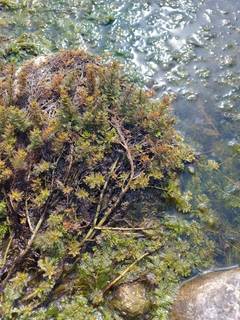
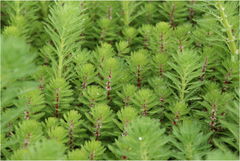
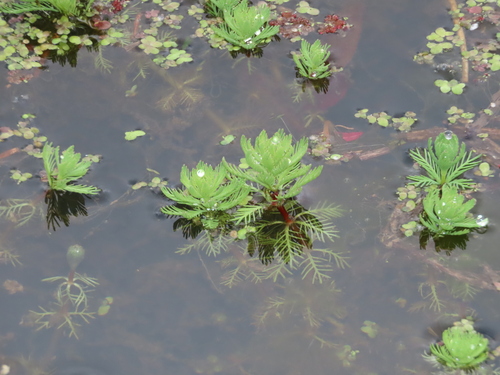
Myriophyllum aquaticum is an emergent and submerged aquatic perennial in the water milfoil family (Haloragaceae) with stems reaching 5-15 feet (1.5-4.5 m) in length, rooted in the substrate and growing through the water column to emerge 6-12 inches (15-30 cm) above the surface. The emergent growth habit separates the species from most other milfoils, which remain fully submerged. Leaves are in whorls of 4-6, finely pinnately divided into 20-30 feather-like segments per leaf, bright blue-green to gray-green, stiff and waxy when emergent and limp when submerged. Emergent leaves give the stems a bottlebrush or miniature-conifer outline. Only female plants are present in North America; reproduction is entirely vegetative. Flowers are tiny white to yellowish inconspicuous flowers produced in the axils of emergent leaves but rarely setting seed without male plants. Stem fragments as short as 1 inch (2.5 cm) with a single node regenerate. Dense floating and emergent mats form on the water surface. Rhizomes anchor in sediment and spread laterally. The species is listed as a Class B noxious weed in Washington State and is still sold in the aquarium and water-garden trade as a decorative plant.
Native Range
Myriophyllum aquaticum is native to South America, from the Amazon basin south through Argentina and Uruguay, in freshwater lakes, ponds, slow-moving streams, and wetlands. Introduced to North America through the aquarium and water-garden trade. Naturalized in the Pacific Northwest, California, and the southeastern United States, particularly in shallow ponds, slow streams, and constructed wetlands.Suggested Uses
Used in aquatic invasive-species identification training, particularly for teaching the emergent-versus-submerged milfoil distinction. Studied in aquatic weed biology for the all-female, vegetatively-reproducing population dynamics in North America. Included in aquatic plant identification courses alongside Egeria densa and Hydrilla verticillata for the submerged aquatic weed complex. The aquarium and water-garden trade pathway is a primary teaching case for ornamental escape invasions.How to Identify
Appearance
Size & Dimensions
Height6" - 1'
Width/Spread2' - 10'
Bloom Information
Tiny inconspicuous white to yellowish flowers in the axils of emergent leaves, borne July through August. Only female plants are present in North America, so viable seed is not produced. Reproduction is entirely vegetative: stem fragmentation, rhizome spread, and rooting at nodes of floating stem fragments.
Detailed Descriptions
Flower Description
White to yellowish; tiny inconspicuous flowers in the axils of emergent leaves; July-AugustFoliage Description
Bright blue-green to gray-green; whorled, finely pinnately divided into feather-like segments; emergent leaves stiff and waxy, submerged leaves limp; evergreenGrowing Conditions
Sun Requirements
Requires 4-10 hours of direct sunlight daily
• Full Sun: 6+ hours of direct sunlight
• Partial Shade: 3-6 hours of direct sunlight
• Full Shade: Less than 3 hours of direct sunlight