Monotropa, Genus, uniflora, Species,
- Genus & species
ghost pipe
Temperate North America and East Asia
Overview
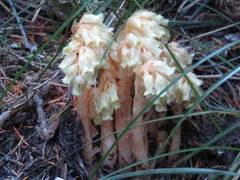
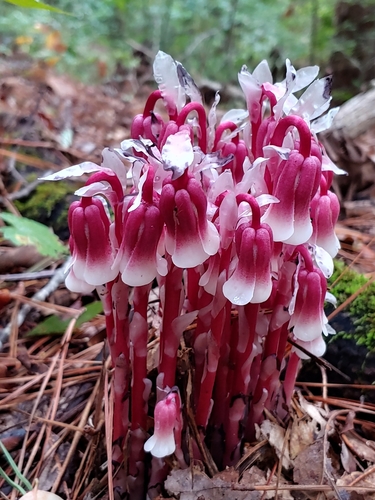
Monotropa uniflora is a non-photosynthetic perennial in the heath family, native to temperate North America and parts of Asia, that contains no chlorophyll and is white, waxy, and translucent throughout. It grows 2-12 inches (5-30 cm) tall as clustered, unbranched stems rising from a mat of brittle roots, with the leaves reduced to small white scales pressed against the stem. Each stem bears a single nodding, bell-shaped flower 0.4-0.8 inch (1-2 cm) long at its tip, with four to five waxy white petals; as the seed ripens the flower turns upright and the whole plant darkens to black. Rather than making its own food, the plant draws carbon from soil fungi that are themselves linked to the roots of nearby trees, so it depends indirectly on those trees and their fungal partners. It grows in the deep shade of rich, moist forest floors thick with leaf litter, often appearing in summer after rain and lasting only a short time. The plant cannot be transplanted or cultivated because of its reliance on specific soil fungi. It bruises and blackens easily when handled and dissolves into a dark, gelatinous mass once cut. The flowers are pollinated by bumblebees.
Native Range
Monotropa uniflora is native to temperate forests of North America, from Canada through the United States into northern South America, and also occurs in temperate East Asia. It grows on shaded, humus-rich forest floors.Suggested Uses
Monotropa uniflora is not a garden plant and cannot be cultivated, as it relies on specific soil fungi linked to forest trees. It is encountered in shaded native woodlands, where it is observed in place rather than grown. Its appearance marks rich, undisturbed forest floor with an established fungal network.How to Identify
Appearance
Size & Dimensions
Height2" - 1'
Width/Spread2" - 6"
Bloom Information
Flowering occurs in summer and early fall, roughly June through September, often emerging within days after rain. Each stem carries one nodding white flower that turns upright as the seed capsule forms. The plant persists above ground only a few weeks before blackening and withering.
Detailed Descriptions
Foliage Description
white scale leaves, no chlorophyllGrowing Conditions
Sun Requirements
Tolerates up to 2 hours of direct sunlight daily
• Full Sun: 6+ hours of direct sunlight
• Partial Shade: 3-6 hours of direct sunlight
• Full Shade: Less than 3 hours of direct sunlight