Monotropa, Genus, spp., Multiple species,
- Genus
- Multiple species
Overview
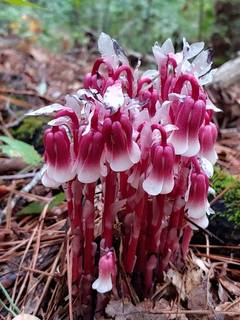
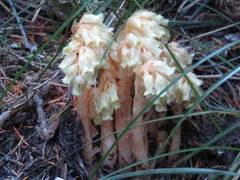
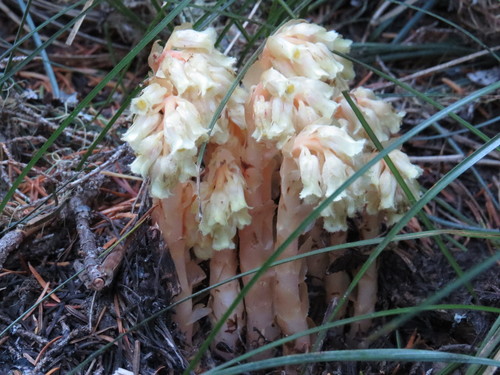
Monotropa is a genus of two to three perennial herbs in the heath family (Ericaceae) that contain no chlorophyll and live as mycoheterotrophs, drawing all their carbon from soil fungi that are in turn linked to the roots of forest trees. Plants emerge as waxy, leafless stalks 2-12 inches (5-30 cm) tall in white, cream, pink, or yellowish tones, with scale-like bracts in place of true leaves. Monotropa uniflora, Indian pipe, carries a single nodding flower per stem, while Monotropa hypopitys, pinesap, bears a short cluster of several flowers. After flowering the stems stiffen, turn upright, blacken, and persist as dry capsules releasing dust-like seeds. Found in shaded, humus-rich forest across the temperate Northern Hemisphere, the genus appears briefly above ground and depends entirely on its fungal partners. Because of this dependence the plants cannot be transplanted or cultivated and are seen only where the right fungi and host trees occur.
Native Range
Monotropa occurs across the temperate Northern Hemisphere, including much of North America, Europe, and Asia, in shaded forests with deep leaf litter. Plants grow on the dark forest floor under conifers and hardwoods where their fungal partners are present.Suggested Uses
Encountered in native woodland and on shaded forest walks rather than in planted gardens, as the genus cannot be cultivated. Of interest in conservation and nature study for its fungal-dependent biology. Its presence indicates an intact forest soil community.How to Identify
Appearance
Size & Dimensions
Height2" - 1'
Width/Spread2" - 6"
Bloom Information
Stems emerge and flower in summer and early autumn, roughly June to September, often after warm rains. The flowers nod while open and turn upward as seed capsules form. Above-ground appearance is brief and varies year to year with moisture and forest conditions.
Detailed Descriptions
Flower Description
White to pink or yellowFoliage Description
White, pink, or yellow scales (no chlorophyll)Growing Conditions
Sun Requirements
Tolerates up to 2 hours of direct sunlight daily
• Full Sun: 6+ hours of direct sunlight
• Partial Shade: 3-6 hours of direct sunlight
• Full Shade: Less than 3 hours of direct sunlight