Micranthes, Genus, stellaris, Species,
- Genus & species
hairy kidney-wort
Mountains of Europe and arctic Eurasia and North America
Overview
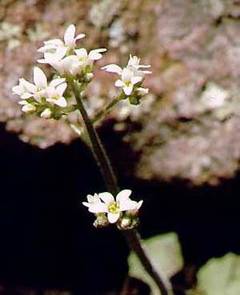
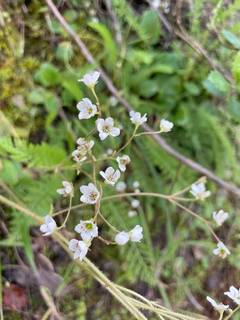
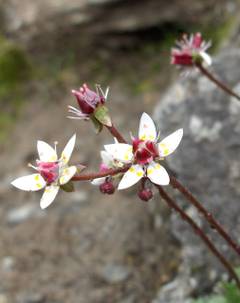
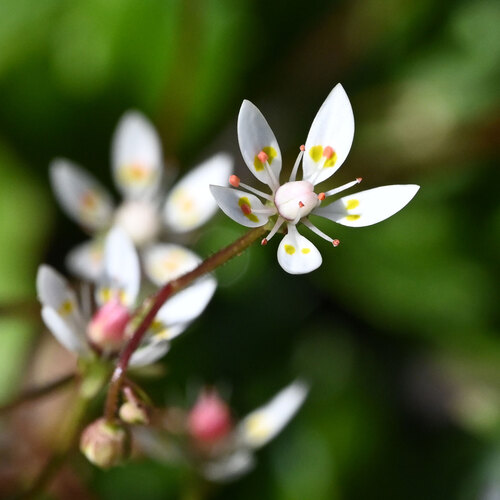
Micranthes stellaris (formerly Saxifraga stellaris) is a perennial of wet mountain rocks and stream sides, forming a loose basal rosette 1-3 inches (2.5-8 cm) across. Leaves are spoon- to wedge-shaped, 0.4-1.2 inches (1-3 cm) long, fleshy, coarsely toothed toward the tip, and edged with short hairs. Flowering stems rise 2-8 inches (5-20 cm) above the rosette, usually leafless and reddish, carrying a loose cluster of a few to about a dozen flowers. Each flower is white and star-shaped, 0.3-0.5 inch (8-12 mm) across, with five narrow petals, each marked with two yellow spots near the base; the anthers are pink to red. Bloom runs from June to August in most sites. After flowering, small reddish capsules release dust-like seed. It grows in cold, constantly wet ground beside springs, flushes, and snow-melt rills, mostly at montane to alpine elevations. It declines where the ground dries out or is shaded by taller vegetation.
Native Range
Native to mountain and northern regions of Europe, including the Alps, Pyrenees, Scandinavian mountains, and the uplands of Britain and Ireland, with related populations across arctic Eurasia and North America. Grows by springs, mountain streams, wet rocks, and snow-melt flushes on acidic substrates, mostly between 1,000 and 11,000 feet (300-3,400 m).Suggested Uses
Grown in alpine troughs, shaded scree beds, and beside streams and pools in rock gardens where moisture stays constant. Also used in collections of arctic-alpine plants. Not suited to dry borders or containers that dry out.How to Identify
Appearance
Size & Dimensions
Height2" - 8"
Width/Spread2" - 6"
Bloom Information
Flowers from June to August, later at higher elevations and in the far north where snow lingers. The white star-shaped flowers are pollinated by small flies and other insects. Capsules ripen in late summer and shed seed before autumn, and some populations also spread by leafy runners.
Detailed Descriptions
Flower Description
white with yellow spots and red anthersFoliage Description
greenGrowing Conditions
Sun Requirements
Requires 3-8 hours of direct sunlight daily
• Full Sun: 6+ hours of direct sunlight
• Partial Shade: 3-6 hours of direct sunlight
• Full Shade: Less than 3 hours of direct sunlight
Care & Maintenance
Care Guide
Grows in cool, partial shade to full sun in ground kept constantly wet by moving water, on acidic, gritty, low-nutrient substrates. In cultivation it needs cold, humid conditions and steady moisture, such as a shaded scree bed or the margin of an alpine stream, and fails in warm, dry, or stagnant sites. Establishes from seed sown on damp grit or from rooted offsets in spring. Summer heat and drought are the main causes of loss in lowland gardens. Crowns rot in still, waterlogged conditions that lack moving water or sharp drainage beneath.Pruning
Spent flower stems can be removed after seeding to tidy the rosette, though removal does not affect plant health. Offsets and runners can be lifted and replanted in spring to maintain a colony. No other pruning is involved.Container Growing
Suitable for container growing