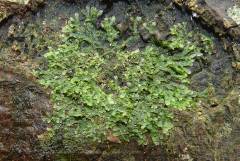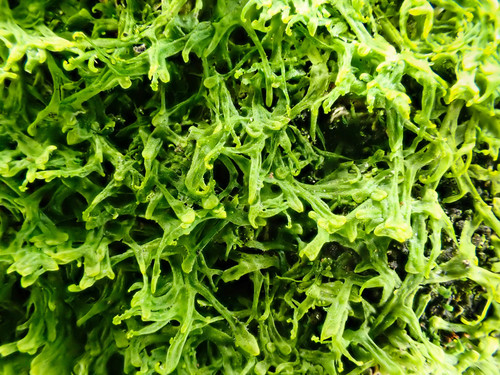
Metzgeria, Genus, violacea, Species,
- Genus & species
bluish veilwort
Mild, humid oceanic regions of Europe and the Americas
SunPart Shade – Full Shade
WaterHigh
Overview
Metzgeria violacea is a small thalloid liverwort in the family Metzgeriaceae that grows as flat, narrow, repeatedly forking green ribbons pressed to tree bark and twigs. Each strap of thallus is about 0.02–0.04 inch (0.5–1 mm) wide, with a thickened midrib and thin, translucent wings one cell thick, and the margins and tips carry clusters of gemmae that are often tinged violet to purplish, the feature behind the name. The gemmae detach and grow into new plants, the main means of spread. Like all liverworts it is non-vascular and can also reproduce by spores from capsules on short stalks, though these form less often. It grows as an epiphyte on the bark of trees and shrubs, especially on twigs and small branches in humid, sheltered woodland and along watercourses, and occasionally on shaded rock. It takes nothing from the host beyond a surface to grow on. The species needs steady humidity and clean air and becomes scarce in dry, exposed, or polluted places.
Native Range
Found across western and central Europe, Macaronesia, and parts of North and South America, mainly in mild, humid, oceanic climates. In Europe it is most frequent in the damp, mild west.Suggested Uses
Metzgeria violacea has no horticultural use and is left undisturbed as part of the natural epiphyte cover on trees. In survey work it is used as an indicator of humid, clean-air, oceanic woodland.How to Identify
Appearance
Bloom Information
As a liverwort, Metzgeria violacea does not flower. It spreads mainly by violet-tinged gemmae shed from the thallus margins and tips through much of the year. Spores from capsules on short, pale stalks form less often, mainly in spring.
Detailed Descriptions
Foliage Description
green with violet-tinged gemmaeGrowing Conditions
Sun Requirements
Tolerates up to 4 hours of direct sunlight daily
• Full Sun: 6+ hours of direct sunlight
• Partial Shade: 3-6 hours of direct sunlight
• Full Shade: Less than 3 hours of direct sunlight
Water & Climate
Water Needs