Metrosideros, Genus, excelsa, Species,
- Genus & species
Pohutukawa
Overview
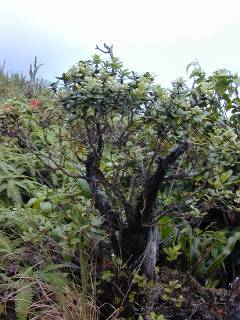
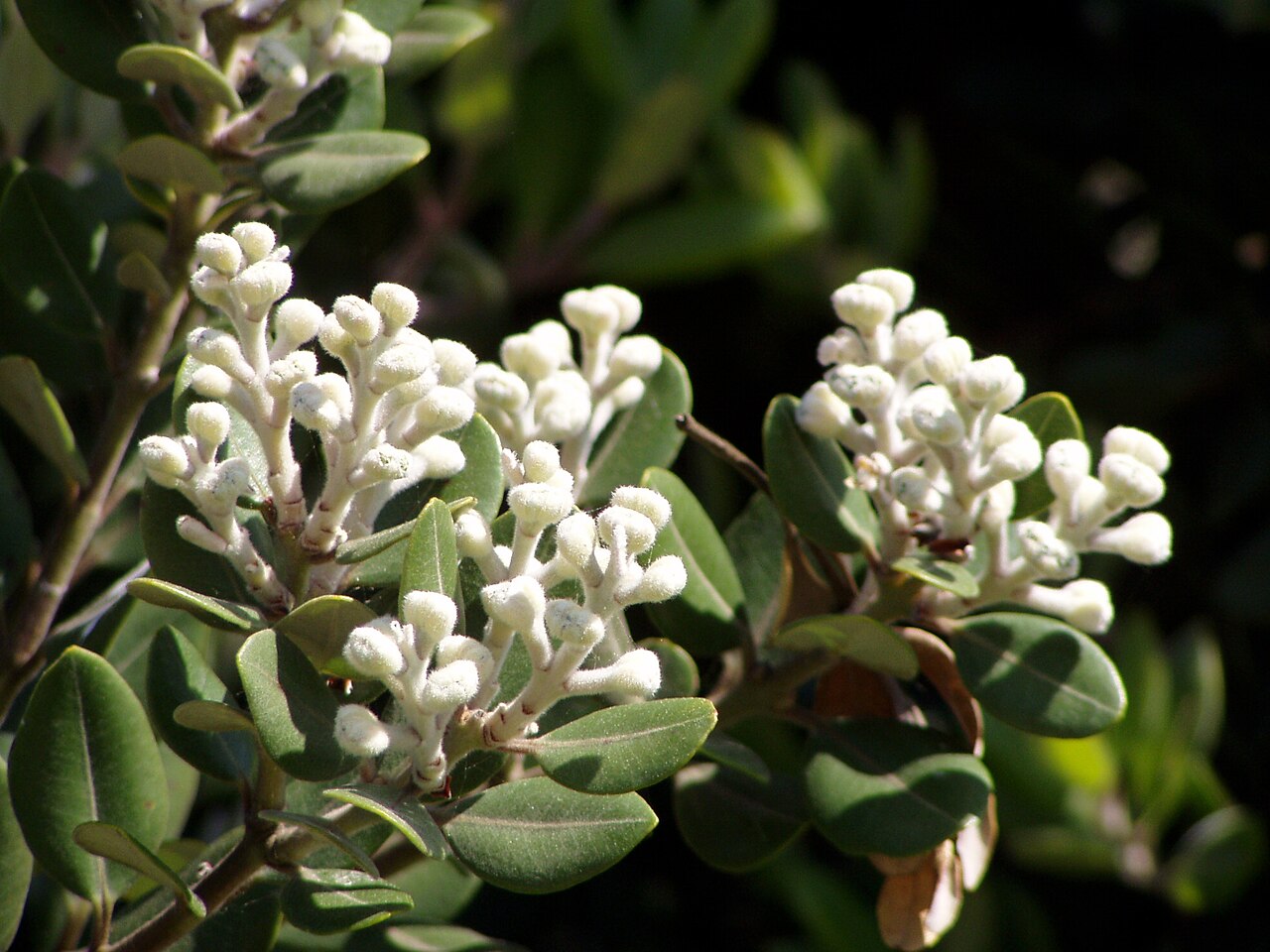
Metrosideros excelsa is an evergreen tree in the Myrtaceae reaching 40-65 feet (12-20 m) tall with a spreading, often multi-trunked crown 33-115 feet (10-35 m) across. Bark is grey-brown and fissured; older trunks and lower branches carry curtains of reddish aerial roots that thicken into secondary trunks where they reach soil. Leaves are opposite, leathery, elliptic to oblong, 2-4 inches (5-10 cm) long and 0.8-2 inches (2-5 cm) wide, dark green above and covered in dense white felted hairs beneath. Flowers open November to January in the southern hemisphere, massed in terminal cymes; each flower is built from 20-40 crimson stamens 1.2-1.6 inches (3-4 cm) long, with reduced petals. Seed capsules ripen over 7-10 months and release wind-dispersed seed. Growth runs 12-24 inches (30-60 cm) per year in coastal conditions and slows inland. The tree withstands salt spray, onshore wind and thin volcanic or sandy soils, but new growth is damaged at 27F (-3C) and whole trees are killed below 23F (-5C), restricting outdoor cultivation to USDA zones 10-11. Root systems are shallow and wide, lifting paving and competing with adjacent planting within 16 feet (5 m). Outside New Zealand it has naturalised on coastal cliffs in South Africa and northern California, where it displaces native shrub cover.
Native Range
Metrosideros excelsa is native to New Zealand, with a natural range covering coastal districts of the northern North Island from Te Paki south to about latitude 39 degrees S, plus scattered inland populations around the Rotorua lakes and geothermal areas. It grows on sea cliffs, rocky headlands, dune margins and old lava flows from sea level to 985 feet (300 m). Populations have contracted across much of this range through browsing by introduced brushtail possums and clearance of coastal land.Suggested Uses
Planted as a street and park tree in coastal cities including Auckland, Sydney, Lisbon and San Francisco, generally spaced 26-39 feet (8-12 m) apart to allow for the spreading crown. Used in windbreaks and for cliff and dune stabilisation on exposed salt-laden sites. In containers of 13 gallons (50 litres) or more it holds at 6.5-10 feet (2-3 m) and flowers within 5-7 years, though root restriction shortens working life to about 15 years.How to Identify
Appearance
Size & Dimensions
Height40' - 65'
Width/Spread33' - 115'
Bloom Information
Flowering runs from late November to mid-January in New Zealand and Australia, peaking over 3-4 weeks. Individual trees vary by up to three weeks in onset, and heavy flowering years alternate with lighter ones on a roughly two-year cycle. Each head stays open 7-10 days before the stamens drop, leaving a red carpet beneath the canopy. Nectar draws tui, bellbirds, honeyeaters and honeybees through the flowering period.
Detailed Descriptions
Foliage Description
Dark green above, white-felted beneathGrowing Conditions
Sun Requirements
Requires 6-12 hours of direct sunlight daily
• Full Sun: 6+ hours of direct sunlight
• Partial Shade: 3-6 hours of direct sunlight
• Full Shade: Less than 3 hours of direct sunlight
Care & Maintenance
Care Guide
Metrosideros excelsa grows in full sun and tolerates 8-12 hours of direct exposure; canopies thin and flowering drops sharply below 6 hours. It establishes on free-draining sand, volcanic scoria, loam and rocky substrates at pH 5.5-7.5, and fails on waterlogged clay. Young trees take weekly irrigation of 5-8 gallons (20-30 litres) through the first two summers, after which established specimens draw on deep soil moisture and tolerate 6-8 weeks without rain. Salt spray and onshore wind cause no leaf damage, though frost below 27F (-3C) kills soft growth. Fertiliser demand is low, met by a single spring application of 1.6 oz per square yard (50 g per square metre) of balanced slow-release feed; high nitrogen produces soft growth with greater frost damage. Myrtle rust (Austropuccinia psidii) infects new growth in warm humid conditions and has caused repeated defoliation in New Zealand and eastern Australia.Pruning
Pruning is carried out in late summer to early autumn after flowering, since flower buds form on the previous season wood. Cuts larger than 2 inches (50 mm) in diameter close slowly and admit decay fungi in humid coastal conditions. Trees respond to hard reduction with dense epicormic regrowth from trunk and main limbs, which returns to an open crown over 5-8 years. Aerial roots can be cut at the branch without harming the tree.Pruning Schedule
Prune: February–March
summerfall
Container Growing
Suitable for container growing
Minimum container size: 13 gallons