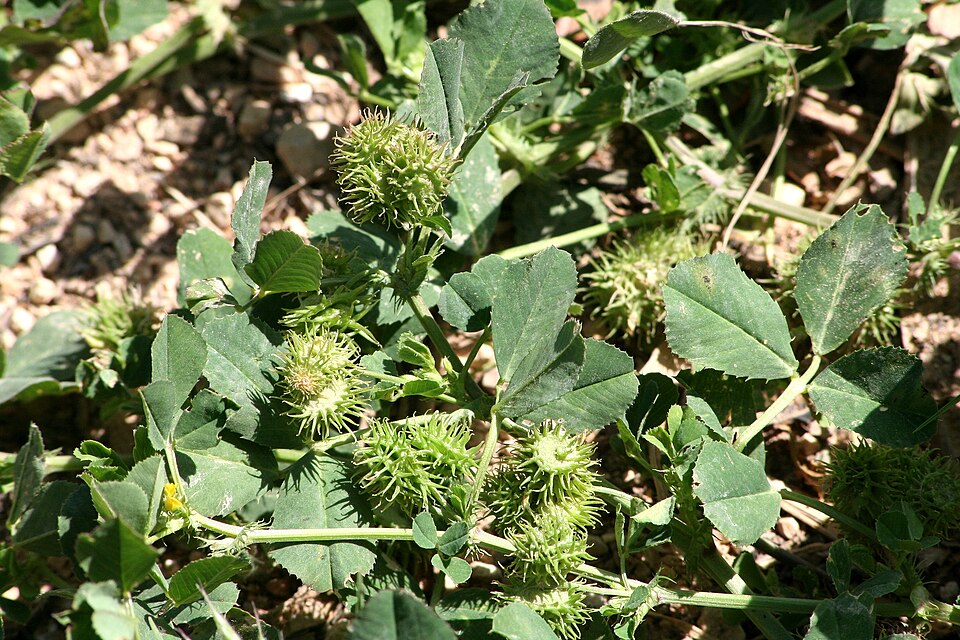
Medicago, Genus, arabica, Species,
- Genus & species
spotted medick
SunFull Sun – Part Shade
Overview
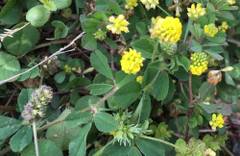
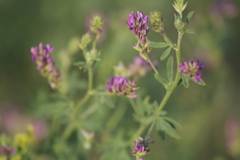
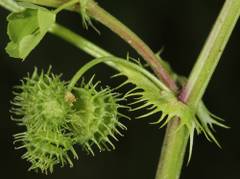
Medicago arabica, spotted medick, is a sprawling annual legume in the pea family (Fabaceae), with trailing stems 4-24 inches (10-60 cm) long forming loose, low patches. The clover-like leaves are divided into three heart-shaped leaflets, each marked with a dark central spot that gives the plant its name. From spring through late summer it bears small yellow pea-shaped flowers, 0.2-0.3 inch (4-6 mm) long, in stalked clusters of one to six. As the flowers fade they form tightly coiled, spiny seed pods that curl into small burs and cling to fur, feathers, and clothing, spreading the seed as animals and people pass. Like other legumes it fixes nitrogen through root nodules, enriching the thin soils where it grows. It is found in grassland, lawns, waysides, disturbed ground, and coastal sand on neutral to alkaline soils in full sun. The plant completes its life cycle in a single season, dying after setting seed, and self-sows freely to return the following year. The burs and free seeding can make it a persistent volunteer in lawns and cultivated ground.
Native Range
Native to Europe, the Mediterranean basin, and western Asia, where it grows on grassland, sandy ground, road verges, and disturbed soils, often near the coast. It has naturalized in North America, Australia, and other temperate regions through its clinging burs.Suggested Uses
Grown in wildflower meadows, conservation seed mixes, and naturalistic grassland where its nitrogen fixing and pollinator flowers suit low-input plantings. Used as a green manure and soil-improving cover on light, poor soils. Its clinging burs make it unsuited to managed lawns and areas used by pets.How to Identify
Appearance
Size & Dimensions
Height4" - 2'
Width/Spread8" - 1'8"
Bloom Information
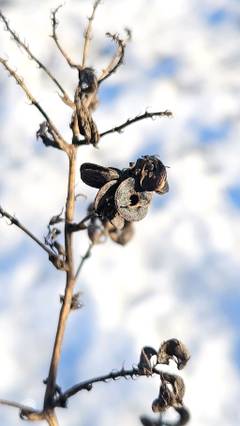
Small yellow flowers open from April into August, a few together on short stalks among the leaves. Bees and other small insects visit them, though the flowers also self-pollinate. Each pollinated flower forms a coiled, spiny pod that ripens to brown and breaks away as a bur.
Detailed Descriptions
Foliage Description
green with dark central blotchGrowing Conditions
Sun Requirements
Requires 5-9 hours of direct sunlight daily
• Full Sun: 6+ hours of direct sunlight
• Partial Shade: 3-6 hours of direct sunlight
• Full Shade: Less than 3 hours of direct sunlight
Water & Climate
Water Needs
Drought Tolerance
Drought tolerant when established
Care & Maintenance
Care Guide
Growth is easy in full sun on free-draining, neutral to alkaline soil of low to moderate fertility, including sandy and stony ground. As an annual it grows quickly from seed in spring, flowers and fruits through summer, then dies, needing no special care in between. It fixes its own nitrogen and needs no feeding, tolerating poor soils that starve other plants. Watering is rarely needed except to establish autumn-sown seedlings in dry spells. Plants self-sow freely, so removing pods before they ripen limits the spread where it is unwanted. The spiny burs can be raked from lawns before they scatter.Pruning
No pruning is needed for this low annual. Removing the spiny pods before they ripen reduces self-seeding and the spread of clinging burs. The whole plant dies back naturally after seeding.Toxicity
Non-toxicPlanting Guide
Planting Methods & Timing
Planting Method
direct sow