Matthiola, Genus, incana, Species,
- Genus & species
Brompton stock
Coastal northern and western Mediterranean
Overview
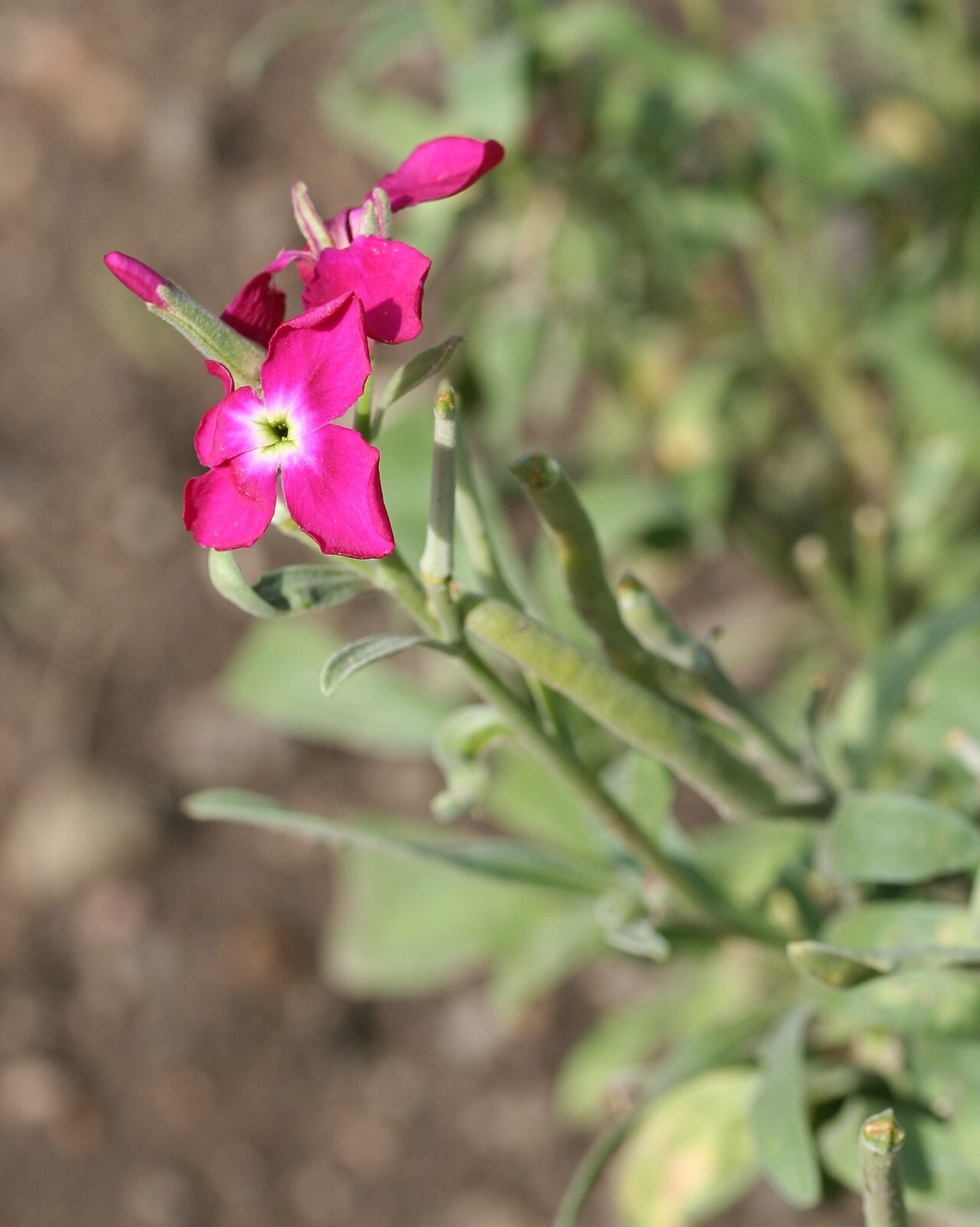
Matthiola incana is a short-lived perennial or subshrub grown in gardens as a biennial or annual. Plants form an upright, sparsely branched stem 12-30 inches (30-75 cm) tall and 10-15 inches (25-38 cm) wide, becoming woody at the base in frost-free climates. Leaves are alternate, narrowly oblong to lance-shaped, 2-4 inches (5-10 cm) long, untoothed, and coated in dense grey felted hairs that give the whole plant a matt grey-green cast. Flowers open in terminal racemes 6-12 inches (15-30 cm) long, each flower 1-1.5 inches (2.5-4 cm) across with four petals in white, cream, pink, rose, crimson, mauve, or deep purple. The clove-like scent carries 10-20 feet (3-6 m) and strengthens after sunset. Garden strains are separated by sowing season: Brompton strains are sown in midsummer, overwintered, and flower the following April to June, while ten-week strains flower 10-12 weeks after sowing. Many seedlings carry a gene for doubled flowers, and single-flowered plants can be removed at the seedling stage by their darker green, narrower cotyledons. Plants fail in heavy wet ground over winter, where crown rot is routine, and flowering stops abruptly once daytime temperatures hold above 80 F (27 C).
Native Range
Matthiola incana is native to the northern and western Mediterranean coasts, from Portugal and Spain through southern France, Italy, and the Adriatic to Greece, with populations in Morocco and the Atlantic islands. Wild plants grow on sea cliffs, limestone outcrops, and stabilised shingle within reach of salt spray. It has naturalised on coastal cliffs in southern Britain, coastal California, and southern Australia.Suggested Uses
Grown in cottage borders, cutting beds, and containers, spaced 10-12 inches (25-30 cm) apart, and positioned near doorways and seating where the evening scent carries. Stems cut when two thirds of the raceme is open hold 7-10 days in water. Coastal gardens use it in exposed sunny beds for its salt-spray tolerance.How to Identify
Appearance
Size & Dimensions
Height1' - 2'6"
Width/Spread10" - 1'3"
Bloom Information
Brompton strains sown the previous July flower from April to June, while ten-week strains sown in spring flower from June to August. Terminal racemes 6-12 inches (15-30 cm) long open from the base upward across 3-4 weeks, and secondary side shoots extend flowering a further 2-3 weeks. Individual flowers last 5-8 days. Scent output peaks after sunset, when the clove-like fragrance draws night-flying moths.
Detailed Descriptions
Flower Description
White, cream, pink, rose, crimson, mauve, or purpleFoliage Description
Grey-greenGrowing Conditions
Sun Requirements
Requires 6-10 hours of direct sunlight daily
• Full Sun: 6+ hours of direct sunlight
• Partial Shade: 3-6 hours of direct sunlight
• Full Shade: Less than 3 hours of direct sunlight
Care & Maintenance
Care Guide
Grows in full sun with 6 or more hours of direct light; in shade the stems stretch and racemes carry fewer flowers. Soil should be free-draining and neutral to alkaline at pH 6.5-7.5, with lime added on acid ground and grit worked into clay. Water demand is moderate at around 1 inch (2.5 cm) per week, applied at the base rather than over the felted foliage, which holds moisture and invites botrytis. Brompton strains are sown in July, overwintered in a cold frame or under cloches in zones 6-7, and set out in early spring. Crowns rot below 20 F (-7 C) in wet ground, though dry-sited plants come through brief frosts to 15 F (-9 C). Clubroot and downy mildew build up where other brassicas have grown, so beds are rotated on a three-year cycle.Pruning
Spent racemes are cut back to a leaf node once two thirds of the flowers have faded, which draws out secondary spikes over the following 2-3 weeks. Plants carried into a second year are reduced by one third after flowering, though regrowth is sparser and the lower stems turn woody. Pods left to ripen split and self-sow, and the resulting seedlings are mainly single-flowered.Pruning Schedule
Prune: May–July
late springsummer
Container Growing
Suitable for container growing
Minimum container size: 2 gallons
Toxicity
Non-toxicPlanting Guide
Planting Methods & Timing
Planting Method
transplant
Indoor Start
8 weeks before last frost
Plant Spacing
12 inches