Lotus, Genus, pedunculatus, Species,
- Genus & species
big bird's-foot trefoil
Europe, western Asia, northern Africa
Overview
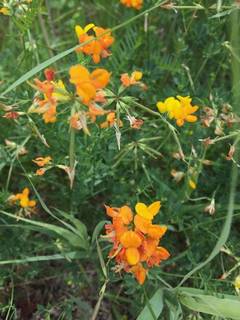
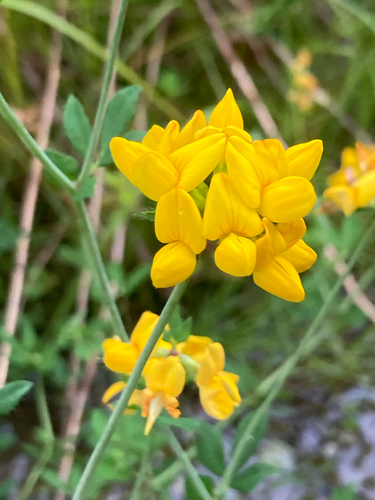
Lotus pedunculatus (syn. L. uliginosus) is a rhizomatous and stoloniferous perennial legume in the pea family (Fabaceae) reaching 12–36 inches (30–90 cm) tall with a 24–60 inch (60–150 cm) spread, forming dense, expanding colonies in moist to wet habitats. Stems are hollow (a key distinction from L. corniculatus), ascending to erect, branching, hairy. Leaves have the same 5-leaflet arrangement as L. corniculatus: 3 terminal leaflets plus 2 stipule-like leaflets at the petiole base, but leaflets are larger, 0.3–0.8 inch (8–20 mm) long. Calyx teeth are spreading in bud, with the two upper teeth reflexed — versus erect, converging calyx teeth in L. corniculatus. Flowers are yellow, 0.4–0.6 inch (10–15 mm) long, papilionaceous, in umbel-like clusters of 5–12 on long peduncles (more flowers per cluster than L. corniculatus). Pods radiate in the bird's-foot pattern, 0.8–1.5 inches (20–38 mm) long. Spreads aggressively by stolons and rhizomes in addition to seed. Contains cyanogenic glycosides. Nitrogen-fixing. Introduced for forage and erosion control on wet sites; persists and invades wet meadows, ditches, and riparian areas.
Native Range
Native to Europe, western Asia, and northern Africa, occurring in wet meadows, ditches, marshes, and streambanks from sea level to approximately 5,000 feet (1,500 m). Introduced to North America for forage on wet, acidic soils. Widely naturalized in the Pacific Northwest, particularly in wet pastures, roadside ditches, and riparian corridors west of the Cascades.Suggested Uses
Used in Fabaceae identification courses alongside L. corniculatus for teaching the solid-versus-hollow stem distinction and calyx tooth orientation. Studied in wet-site forage agronomy, nitrogen fixation on acidic soils, and wetland invasion ecology. The paired Lotus species (dry-site L. corniculatus versus wet-site L. pedunculatus) demonstrate habitat partitioning in introduced legumes.How to Identify
Appearance
Size & Dimensions
Height1' - 3'
Width/Spread2' - 5'
Bloom Information
Detailed Descriptions
Foliage Description
Medium to dark green, pinnately compound with 5 leaflets (3 terminal + 2 stipule-like at petiole base), hairyGrowing Conditions
Sun Requirements
Requires 4-10 hours of direct sunlight daily
• Full Sun: 6+ hours of direct sunlight
• Partial Shade: 3-6 hours of direct sunlight
• Full Shade: Less than 3 hours of direct sunlight