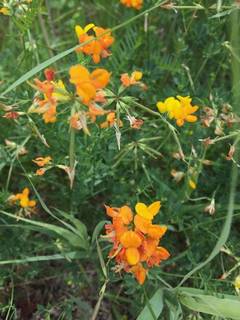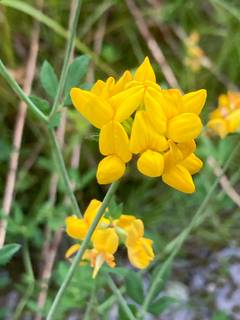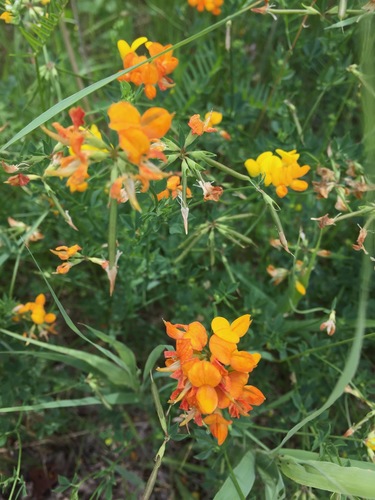
Lotus, Genus, spp., Multiple species,
- Genus
- Multiple species
bird's-foot trefoils
Europe, Mediterranean, Asia, and Africa
Overview
Lotus is a genus of legumes in the pea family (Fabaceae) that, in its current narrower sense, contains around 100 species of annual and perennial herbs and subshrubs native to Europe, Asia, and Africa, including the Canary Islands. The common name bird's-foot trefoil refers to the clusters of slender seed pods that spread like the toes of a bird's foot, and the leaves that appear to have three leaflets but actually carry five. Plants range from low creeping mats 2-6 inches (5-15 cm) tall to bushy or trailing stems 12-24 inches (30-60 cm) long. Pea-type flowers 0.3-0.6 inch (8-15 mm) long are carried in small stalked clusters in yellow, orange, and red, often aging to deeper tones, and are followed by the characteristic splayed pods. As legumes, these plants fix nitrogen through root nodules and grow in lean soils. L. corniculatus is grown as forage and erosion cover and has naturalized widely, becoming weedy in some regions, while the trailing L. berthelotii is grown for its silvery foliage and red beak-shaped flowers. Most species tolerate drought once established. Some contain compounds that can release small amounts of cyanide in bruised foliage.
Native Range
Lotus species in the narrow sense are native to Europe, the Mediterranean, temperate Asia, and Africa, with a concentration of trailing species on the Canary Islands. L. corniculatus has naturalized across North America, Australia, and New Zealand, where it is sometimes managed as a weed.Suggested Uses
Creeping Lotus species are used as ground cover, erosion control on banks, and forage in meadows and pasture, sown to form a low nitrogen-fixing mat. The trailing L. berthelotii is grown in hanging baskets, window boxes, and over walls for its silvery foliage. Low species suit gravel gardens and the front of sunny borders.How to Identify
Appearance
Size & Dimensions
Height2" - 2'
Width/Spread1' - 3'
Bloom Information
Most Lotus species bloom from late spring through summer, roughly May to September, with scattered later flowers in mild conditions. The small pea flowers open over many weeks as the clusters develop in succession. L. berthelotii flowers in a concentrated flush in late spring and early summer.
Detailed Descriptions
Flower Description
yellow, orange, or redFoliage Description
green to silver-greyGrowing Conditions
Sun Requirements
Requires 6-12 hours of direct sunlight daily
• Full Sun: 6+ hours of direct sunlight
• Partial Shade: 3-6 hours of direct sunlight
• Full Shade: Less than 3 hours of direct sunlight
Water & Climate
Water Needs
Drought Tolerance
Drought tolerant when established
Care & Maintenance
Care Guide
These plants grow in full sun and well-drained soil, from sand to loam, tolerating poor, dry, and alkaline ground at a pH near 6.0 to 8.0. As nitrogen-fixing legumes they need no supplemental feeding and grow where many plants run short of nutrients. Established plants are drought-tolerant and stand heat, coastal exposure, and occasional mowing. Wet, heavy, poorly drained soils cause root rot and short-lived plants. L. corniculatus self-seeds and creeps freely, which makes it persistent in lawns and rough ground, while the tender L. berthelotii needs frost protection and is grown as an annual or container plant in cold climates. The foliage can contain cyanogenic compounds, so large quantities are unsafe for grazing animals.Pruning
Trimming or shearing after the first bloom keeps creeping and trailing species dense and can prompt more flowers. Trailing container species are cut back lightly to maintain shape. Spent stems of perennial species are cut to the base in late autumn or early spring.Container Growing
Suitable for container growing