Overview
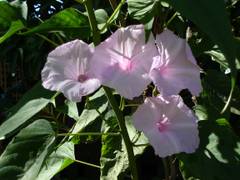
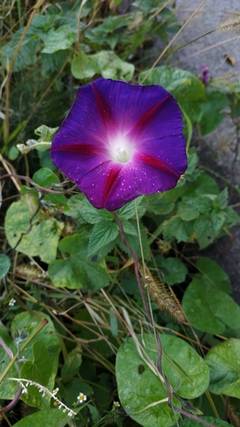
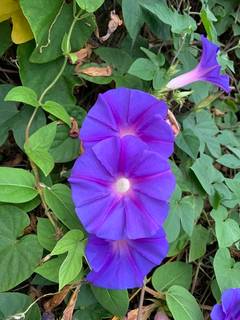
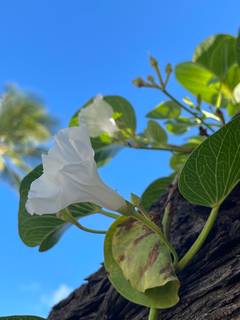
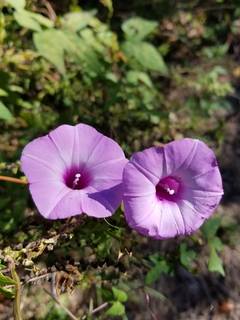
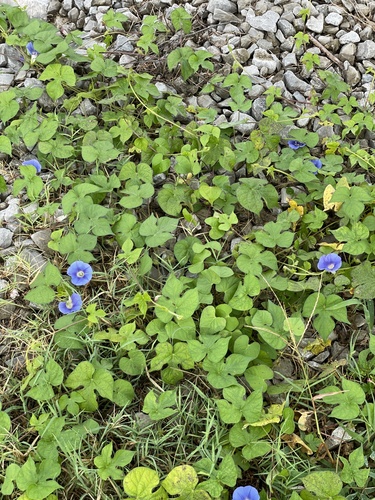
Ipomoea hederacea is a twining annual vine in the morning-glory family, climbing 3-6 feet (0.9-1.8 m) by scrambling over supports. Its leaves are usually three-lobed and ivy-like, though some are unlobed and heart-shaped, all carried on hairy stems. From summer into autumn it opens funnel-shaped flowers about 1 inch (2.5 cm) across, blue to purple with a paler throat, fading by midday. The flowers are backed by long, narrow, tapering sepals covered in spreading hairs and curved outward at the tips, a feature that separates this species from related morning-glories. Each flower gives way to a rounded capsule of dark seeds, which contain alkaloids toxic if eaten in quantity. Native to tropical America, it has naturalized across much of the warmer United States, where it grows on roadsides, field edges, and disturbed ground and is treated as an agricultural weed in row crops. It germinates and reseeds prolifically, so it can persist and spread well beyond where it is first sown.
Native Range
Ipomoea hederacea is native to tropical America, including Mexico, Central America, and parts of South America. It has naturalized widely across the central, southern, and eastern United States.Suggested Uses
Grown on trellises, fences, and arbors as a fast summer screen, and in cottage and annual plantings for its morning flowers. It covers bare vertical supports within a single season. Its weedy reseeding limits use to areas where volunteers can be managed.How to Identify
Appearance
Size & Dimensions
Height3' - 6'
Width/Spread1' - 2'
Bloom Information
Detailed Descriptions
Flower Description
blue to purpleFoliage Description
greenGrowing Conditions
Sun Requirements
Requires 6-10 hours of direct sunlight daily
• Full Sun: 6+ hours of direct sunlight
• Partial Shade: 3-6 hours of direct sunlight
• Full Shade: Less than 3 hours of direct sunlight
Water & Climate
Water Needs
Drought Tolerance
Drought tolerant when established
Care & Maintenance
Care Guide
Grow Ipomoea hederacea in full sun on a trellis, fence, or other support it can twine through. It grows in average, well-drained soil and tolerates heat and lean ground, flowering more sparsely in rich soil that favors leafy growth. Seed is sown directly after the last frost, with soaking or nicking of the hard coat to speed germination. Water young plants until established, then occasionally. Because it self-sows heavily and can become weedy, spent capsules are removed before the seeds ripen where spread is unwanted. The seeds contain alkaloids toxic if eaten.Pruning
No structural pruning is required for this annual. Stems can be pinched to encourage branching and cut back to keep the vine within its support. Spent capsules are removed before they ripen to limit self-seeding.Toxicity Warning
Toxic to pets and humansPlanting Guide
Planting Methods & Timing
Planting Method
direct sow
Plant Spacing
12 inches