Iberis, Genus, saxatilis, Species,
- Genus & species
rock candytuft
Mountains of southern Europe: Pyrenees, Alps, Apennines, Balkans
Overview
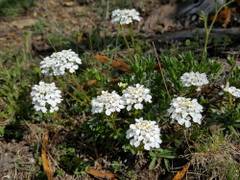
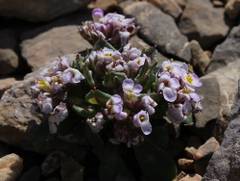
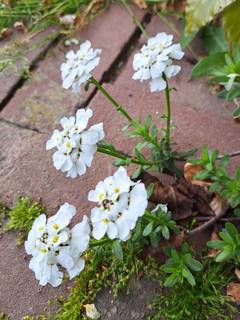
Iberis saxatilis is a compact evergreen subshrub in the family Brassicaceae growing 3-6 inches (8-15 cm) tall and 8-12 inches (20-30 cm) wide, forming a dense low mound of dark green fleshy linear leaves 0.3-0.75 inch (8-18 mm) long. Stems are woody at the base and herbaceous toward the tips. Flowers are small, white, four-petaled, 0.3 inch (8 mm) across, arranged in dense flat-topped corymbs 1-1.5 inches (2.5-4 cm) across that nearly obscure the foliage at peak bloom. The outer two petals of each flower are larger than the inner two, a character of the genus Iberis that separates it from other crucifer genera. After flowering, the corymbs elongate slightly as siliculate seed pods develop. The species is native to rocky calcareous habitats in the mountains of southern Europe, where it grows on limestone cliffs, scree, and rocky outcrops at 3,000-8,000 feet (900-2,400 m). The species is the smallest perennial candytuft in cultivation at 3-6 inches tall, considerably smaller than I. sempervirens at 6-12 inches. Tolerates drought, heat, and alkaline soil. Does not tolerate waterlogged conditions or heavy clay. Long-lived for a subshrub: plants persist 8-15 years in well-drained sites.
Native Range
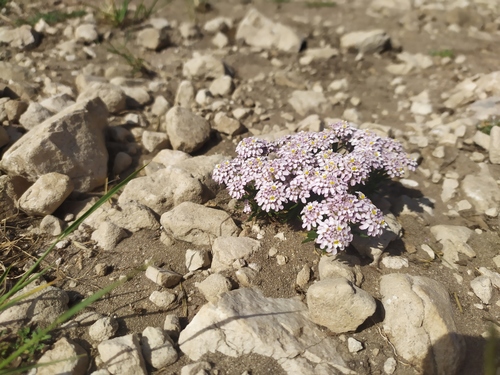
Iberis saxatilis is native to the mountains of southern Europe, from the Pyrenees through the Alps, Apennines, and into the Balkan mountains. The species occurs on calcareous rock faces, cliff crevices, and scree at elevations of 3,000-8,000 feet (900-2,400 m).Suggested Uses
Planted in rock gardens, crevice gardens, alpine troughs, and wall tops, spaced 8-10 inches (20-25 cm) apart. Used as edging along gravel paths and raised beds. The compact evergreen mound gives year-round structure. Tolerates alkaline soil and coastal exposure. Not suited to heavy clay or wet conditions.How to Identify
Appearance
Size & Dimensions
Height3" - 6"
Width/Spread8" - 1'
Bloom Information
White corymbs open from April through May, covering the mound in a dense layer of flowers. Peak bloom lasts 3-4 weeks. Light rebloom may occur in autumn in the Pacific Northwest if conditions are cool and moist. Pollinated by small bees and flies.
Detailed Descriptions
Flower Description
White; small four-petaled 0.3 inch (8 mm) across; in dense flat-topped corymbs 1-1.5 inches (2.5-4 cm); outer two petals larger than inner twoFoliage Description
Dark green; fleshy linear 0.3-0.75 inch (8-18 mm); evergreenGrowing Conditions
Sun Requirements
Requires 6-10 hours of direct sunlight daily
• Full Sun: 6+ hours of direct sunlight
• Partial Shade: 3-6 hours of direct sunlight
• Full Shade: Less than 3 hours of direct sunlight
Care & Maintenance
Care Guide
Sited in full sun in sharply drained neutral to alkaline gritty soil at pH 7.0-8.5. Spaced 8-10 inches (20-25 cm) apart. Heavy soils are amended with coarse grit and limestone chips. Fertilizer is not used since lean soil maintains the compact habit. Watered sparingly; drought-tolerant once established. Mulched with gravel or stone chips, not organic material. In the Pacific Northwest, sited in a raised bed, rock garden, or wall top to ensure winter drainage.Pruning
Sheared lightly after flowering in May, cutting back by one-third to maintain a compact dense mound and limit legginess. Cuts into old bare wood are avoided. No other pruning is required.Pruning Schedule
Prune: June
summer
Container Growing
Suitable for container growing
Minimum container size: 1 gallons