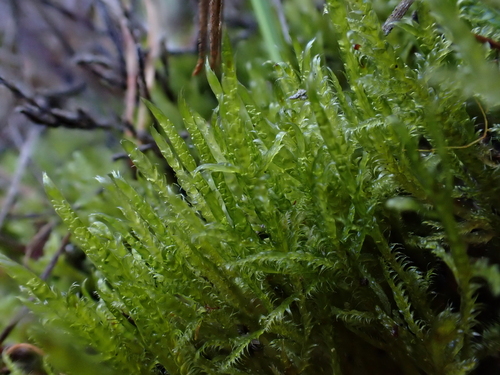
Overview
Hypnum jutlandicum is a spreading, mat-forming moss of the feather-moss group, with creeping main stems 1–4 inches (3–10 cm) long that branch in a regular, pinnate pattern to form soft, pale yellow-green to golden wefts. The small leaves curve strongly to one side (falcate-secund), giving each shoot a neat, plaited look that the common name reflects. It is a non-vascular plant, lacking true roots, conducting tissue, and flowers; it anchors by slender rhizoids and absorbs water and minerals directly over its surface. The species grows over acidic ground, including heathland, moorland, peat, decaying logs, tree bases, and the floor of conifer and birch woodland, where it tolerates low nutrients and periodic drying. It is widespread across Britain, Ireland, and much of Europe, extending into cooler parts of North America. Spore capsules are produced infrequently, raised on reddish stalks (setae) about 0.4–0.8 inch (10–20 mm) tall, with a curved, cylindrical capsule. It is sensitive to lime and to heavy, fertile soils, and is most often found where competition from taller plants is low.
Native Range
Hypnum jutlandicum is native across Europe, from Britain and Ireland through Scandinavia and central Europe, and extends into cooler parts of North America and northern Asia. It grows on acidic heaths, moorland, peat, and the floor of conifer and birch woodland.Suggested Uses
Used in moss gardens, shaded acidic rockeries, terraria, and bonsai underplantings where a low, spreading green carpet is wanted. It also stabilizes the surface of peat and acidic soil in naturalistic plantings.How to Identify
Appearance
Size & Dimensions
Height1" - 4"
Bloom Information
As a moss, it produces no flowers. Spore capsules form occasionally, mostly maturing in winter and spring, on short reddish stalks. Reproduction also occurs by fragments of stem that root and grow into new mats.
Detailed Descriptions
Foliage Description
pale yellow-green to golden

