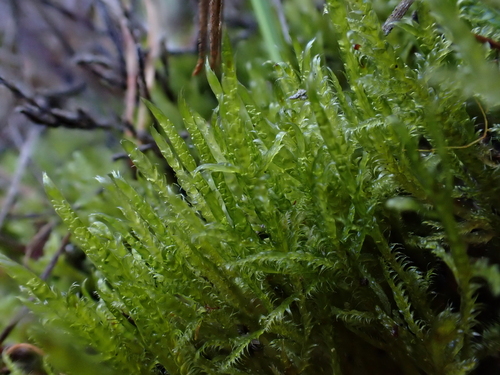
Hypnum, Genus, spp., Multiple species,
- Genus
- Multiple species
feather moss
Cosmopolitan; temperate and boreal regions worldwide
Overview
Hypnum is a genus of about 30 pleurocarpous mosses in the family Hypnaceae, found on every continent. Plants form flat, spreading mats or wefts over soil, rock, rotting logs, and the bases of trees in woodland, heath, and disturbed ground. The creeping main stems branch in a regular pinnate pattern, and the small overlapping leaves curve to one side (falcate-secund), giving each shoot a combed look that names the group feather moss. Mats run 0.4 to 2 in (1 to 5 cm) deep and spread across a surface. H. cupressiforme, the cypress-leaved feather moss, occurs over a wide range of substrates and climates and is the species most people meet. Color shifts from green in shade and moisture to golden or yellow-green under stronger light. Like all mosses the genus bears no flowers or true roots; it anchors by rhizoids and reproduces by spores released from stalked capsules. The mats dry and curl in drought, then green up again when rewetted, though long exposure on hot, dry sites thins the colony.
Native Range
The genus is cosmopolitan, native to temperate and boreal regions across all continents. H. cupressiforme and its relatives are widespread through the Northern Hemisphere.Suggested Uses
Used as a groundcover in shaded, damp settings, between stepping stones, and over rocks and logs in woodland gardens. The genus features in moss gardens, terrariums, and bonsai underplantings. Mats hold surface moisture and shelter small invertebrates.How to Identify
Appearance
Size & Dimensions
Height1" - 2"
Width/Spread6" - 3'
Colors
Foliage Colors
Fall Foliage Colors
Bloom Information
Mosses do not flower. Spore capsules ripen mainly from autumn into winter, releasing spores when the lid drops and the capsule mouth dries. Vegetative spread from stem fragments continues year-round.
Detailed Descriptions
Foliage Description
green to golden yellow-greenGrowing Conditions
Sun Requirements
Tolerates up to 4 hours of direct sunlight daily
• Full Sun: 6+ hours of direct sunlight
• Partial Shade: 3-6 hours of direct sunlight
• Full Shade: Less than 3 hours of direct sunlight
Care & Maintenance
Care Guide
Plants grow in part to full shade on acidic, moisture-retentive surfaces such as bark, rock, peat, or compacted soil. Steady humidity and indirect light keep the mats green, while drying turns them dull and curled until rain returns. No fertilizer is needed, as mosses take up water and minerals directly through their leaves. Established mats tolerate short droughts and recover after rewetting. In gardens, patches are pressed onto a firmed, weed-free surface and misted until anchored. Fallen tree leaves left on the mat block light and cause patches to brown.Pruning
No pruning is required. Patches can be lifted, divided, and pressed onto new ground to extend a colony. Clearing fallen leaves and debris from the surface keeps the mat lit and green.Container Growing
Suitable for container growing


