Heracleum, Genus, maximum, Species,
- Genus & species
Cow parsnip
Alaska south through British Columbia, Washington, Oregon to California, and east to the Atlantic coast; moist meadows, stream banks, forest edges, and disturbed moist ground
Overview
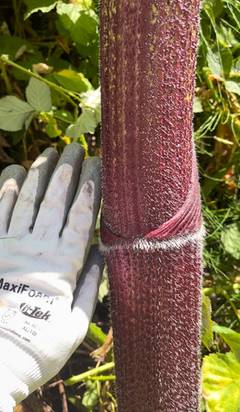
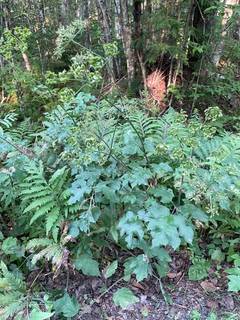
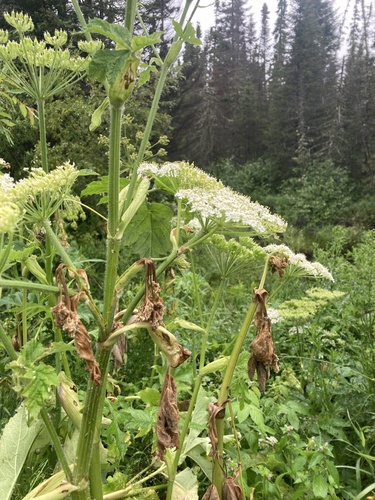
Heracleum maximum is an upright deciduous herbaceous perennial reaching 4-9 feet (1.2-2.7 m) tall and 3-5 feet (90-150 cm) wide, larger at maturity than most native herbaceous plants of western North America. Hollow hairy green stems support very large palmately 3-lobed leaves up to 12-24 inches (30-60 cm) across. Small white five-petaled flowers gather in flat-topped compound umbels 4-12 inches (10-30 cm) wide from June through August over 6 weeks — the typical Apiaceae structure. Native to North America from Alaska south through British Columbia, Washington, Oregon, and California, and east to the Atlantic coast. Found in moist meadows, on stream banks, at forest edges, and in disturbed moist ground. The sap contains furanocoumarins; skin contact followed by UV exposure causes phytophotodermatitis — severe blistering burns lasting weeks and sometimes leaving permanent dark scarring. Native cow parsnip is sometimes confused with the introduced invasive giant hogweed (H. mantegazzianum), which reaches 10-20+ feet (3-6+ m), bears purple-blotched stems, produces umbels up to 24 inches (60 cm) across, and is more severely phototoxic. Indigenous peoples have traditionally harvested young peeled stalks and leaf bases as a cooked vegetable, with expert identification and processing required. Important nectar source for hundreds of insect species. Hardy in USDA zones 3-9.
Native Range
Native to North America from Alaska south through British Columbia, Washington, Oregon, and California, and east to the Atlantic coast. Found in moist meadows, on stream banks, at forest edges, and in disturbed moist ground.Suggested Uses
Used in large native plant gardens, meadow restoration plantings, riparian buffer plantings, and pollinator gardens, spaced 3-5 feet (90-150 cm). Toxicity of the sap is relevant where plantings are sited near patios, paths, or play areas. Distinct from invasive H. mantegazzianum (giant hogweed) by green stems and shorter mature height.How to Identify
Appearance
Size & Dimensions
Height4' - 9'
Width/Spread3' - 5'
Bloom Information
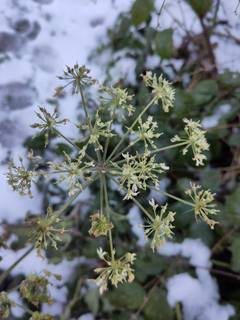
White small five-petaled flowers in flat-topped compound umbels 4-12 inches (10-30 cm) appear from June through August over 6 weeks — the typical Apiaceae structure. Bee-, butterfly-, beetle-, and fly-pollinated; the species supports hundreds of insect species. Bloom timing tracks elevation: low-elevation populations begin in early June, while subalpine populations may not flower until late July.
Detailed Descriptions
Flower Description
White, small five-petaled flowers in large flat-topped compound umbels 4-12 inches (10-30 cm) across — the typical Apiaceae structure; the species supports hundreds of insect species as a summer nectar source for native pollinators; June-AugustFoliage Description
Medium to dark green; very large palmately 3-lobed leaves up to 12-24 inches (30-60 cm) across; hollow hairy green stems separate the species from the invasive Heracleum mantegazzianum (giant hogweed), whose stems are purple-blotched; turns yellow to tan in fall; the sap is phototoxic — direct skin contact combined with UV exposure causes severe blisteringGrowing Conditions
Sun Requirements
Requires 3-8 hours of direct sunlight daily
• Full Sun: 6+ hours of direct sunlight
• Partial Shade: 3-6 hours of direct sunlight
• Full Shade: Less than 3 hours of direct sunlight
Care & Maintenance
Care Guide
Grows in part sun to full sun with 3-8 hours direct light. Tolerates clay, loam, and silt at pH 5.0-7.5; moist conditions are required. Hardy in USDA zones 3-9. The sap is phototoxic: direct skin contact followed by UV exposure causes severe blistering (phytophotodermatitis), and standard practice during handling involves long sleeves, long pants, gloves, and eye protection. Native populations are sometimes confused with invasive H. mantegazzianum (giant hogweed), which is taller (10-20+ ft / 3-6+ m), has purple-blotched stems, and is regulated as a Federal Noxious Weed.Pruning
Spent flower stalks are removed in October or November after seeds mature. Standard practice during cutting involves long sleeves, gloves, and eye protection because the sap is phototoxic. No other pruning required.Pruning Schedule
Prune: October–November
fall