Heracleum, Genus, mantegazzianum, Species,
- Genus & species
giant hogweed
Caucasus Mountains (southwestern Russia, Georgia)
Overview
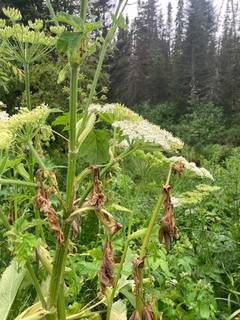
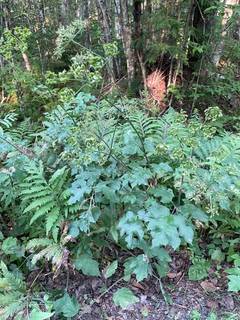
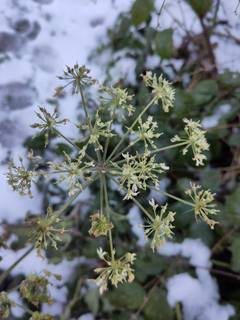
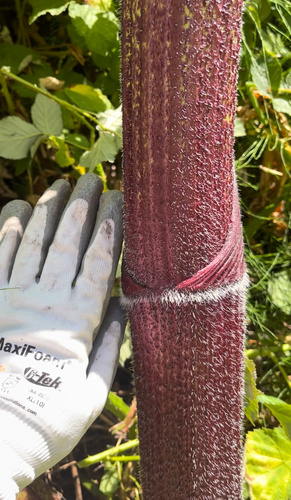
Heracleum mantegazzianum is a massive, monocarpic or short-lived perennial in the carrot family (Apiaceae) reaching 6–15 feet (1.8–4.5 m) tall with a 4–8 foot (1.2–2.4 m) spread. The largest herbaceous plant in the Pacific Northwest weed flora. Stems are erect, hollow, 2–4 inches (5–10 cm) in diameter, green with dark reddish-purple blotches and coarse white hairs. Leaves are ternately compound, deeply 3-lobed with each lobe further incised into sharply pointed segments, reaching 3–5 feet (0.9–1.5 m) across on the basal rosette, with petioles up to 36 inches (90 cm) long. Leaf lobe incisions extend more than halfway to the midrib (key distinction from Heracleum maximum). Flowers are white, in compound umbels up to 30 inches (75 cm) across — the largest umbels of any Apiaceae in North America. Plants typically grow as a basal rosette for 3–5 years before bolting, flowering once, and dying (monocarpic). A single plant produces 20,000–100,000 seeds. Seeds remain viable in soil for 7–15 years. The sap contains linear furanocoumarins (psoralen, bergapten, xanthotoxin) that cause phytophotodermatitis: severe burns, blistering, and scarring when skin contacts sap and is then exposed to ultraviolet light. Burns can require hospitalization. Sap contact with eyes can cause temporary or permanent blindness. Listed as a federal noxious weed in the United States and a Class A noxious weed in Washington State (mandatory eradication).
Native Range
Native to the western Caucasus Mountains of southwestern Russia and Georgia, occurring in subalpine meadows, stream corridors, and forest clearings at 3,000–7,000 feet (900–2,100 m). Introduced to Europe and North America in the 19th century as a botanical garden specimen and ornamental curiosity. Naturalized in the Pacific Northwest, northeastern United States, and across northern and western Europe, primarily along waterways, roadsides, and disturbed moist sites.Suggested Uses
Used as a primary case study in hazardous invasive species identification training for parks, roads, and public works staff. The phytophotodermatitis mechanism is taught in toxicology and plant chemistry courses. Distinguished from the native H. maximum in field identification exercises — a critical public safety distinction, as H. maximum also contains furanocoumarins but at lower concentrations. Reporting protocols and agency coordination are included in noxious weed management curricula.How to Identify
Appearance
Size & Dimensions
Height6' - 15'
Width/Spread4' - 8'
Bloom Information
Flowers from June through August after 3–5 years of vegetative rosette growth. The massive compound umbel blooms for 2–4 weeks. Plants are monocarpic: they flower once and die, but lateral root buds occasionally produce secondary rosettes. Seeds mature by August through September and fall near the parent plant; water dispersal carries seeds along waterways. In the Pacific Northwest, peak bloom occurs in July.
Detailed Descriptions
Foliage Description
Dark green, deeply 3-lobed, each lobe further incised with sharply pointed segments; lobes deeply cut more than halfway to the midribGrowing Conditions
Sun Requirements
Requires 4-12 hours of direct sunlight daily
• Full Sun: 6+ hours of direct sunlight
• Partial Shade: 3-6 hours of direct sunlight
• Full Shade: Less than 3 hours of direct sunlight