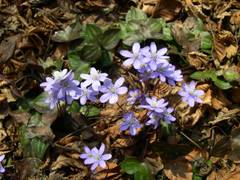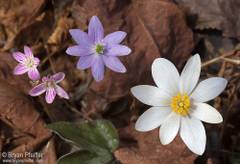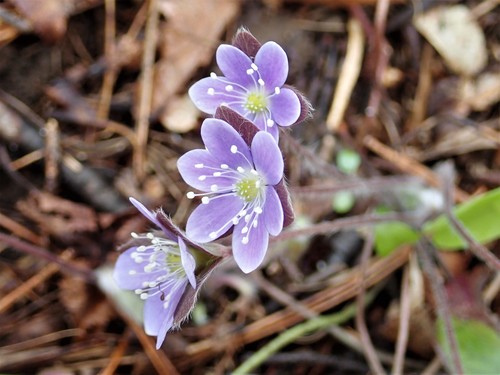
Hepatica, Genus, americana, Species,
- Genus & species
round-lobed hepatica
Overview
Hepatica americana is a low evergreen perennial in the buttercup family (Ranunculaceae), forming a basal clump 4–6 inches (10–15 cm) tall and 6–9 inches (15–23 cm) wide. The leaves are leathery, three-lobed with rounded tips, and 1–3 inches (2.5–7.5 cm) wide, emerging green and aging to maroon or bronze through winter before being replaced by new growth in spring. From March to April, hairy flower stalks rise above the old leaves bearing solitary flowers 0.5–1 inch (12–25 mm) across, with 5–12 petal-like sepals in shades of lavender, pink, white, or blue. There are no true petals; the color comes from the sepals, subtended by three small green bracts. New leaves unfold after flowering and persist through the following winter. The plant grows slowly from a short rhizome and forms small colonies in rich woodland over many years. It grows in the leaf litter of deciduous forests on slightly acidic soils. Flowering is brief and depends on early spring warmth, with blooms lasting two to three weeks. All parts contain protoanemonin and are mildly toxic if eaten.
Native Range
Native to eastern North America, from Nova Scotia and Ontario south to Georgia and west to Missouri. It grows in dry to moist deciduous and mixed woodlands, often on wooded slopes and in leaf litter over acidic soils.Suggested Uses
Used in shade and woodland gardens, native plant borders, and rock gardens with humus-rich soil. Suited to the front of shaded beds and naturalized drifts under deciduous trees. Grown among spring ephemerals such as Sanguinaria canadensis and Trillium species.How to Identify
Appearance
Size & Dimensions
Height4" - 6"
Width/Spread6" - 9"
Bloom Information
Blooms from March to April, among the earliest woodland wildflowers to open. Each flower lasts several days, and a clump flowers over two to three weeks. The petal-like sepals close at night and in cloudy weather, opening again in sun.
Detailed Descriptions
Flower Description
lavender, pink, white, or blueFoliage Description
green, maroon in winterGrowing Conditions
Sun Requirements
Tolerates up to 4 hours of direct sunlight daily
• Full Sun: 6+ hours of direct sunlight
• Partial Shade: 3-6 hours of direct sunlight
• Full Shade: Less than 3 hours of direct sunlight
Care & Maintenance
Care Guide
Grows in part to full shade in humus-rich, well-drained woodland soil with a slightly acidic pH of 5.5–6.5. Consistent moisture in spring suits it, followed by drier conditions in summer once growth slows. A mulch of leaf litter mimics the native woodland floor and protects the shallow rhizome. It is slow to recover from root disturbance, so clumps are left undivided once sited. Growth is slow, and colonies take several years to fill in. Hardy in USDA zones 4 to 8.Pruning
No routine pruning is needed. Old leaves are removed in early spring just before flowering to expose the blooms, though they can be left to die back naturally. Spent flower stalks are trimmed after seed drop where self-sowing is not wanted.Pruning Schedule
Prune: March
early spring
Container Growing
Suitable for container growing
Minimum container size: 1 gallons