Hakea, Genus, sericea, Species,
- Genus & species
bushy needlebush
Overview
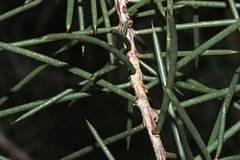
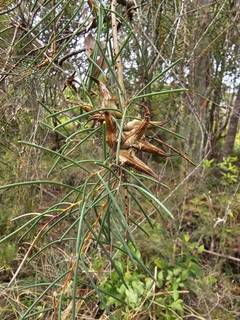
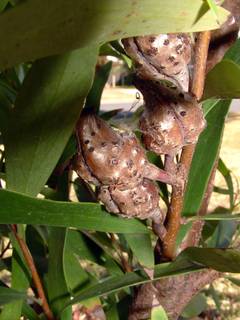
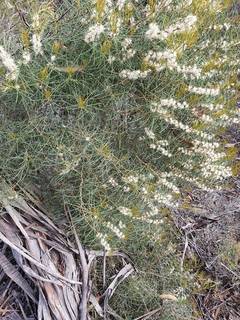
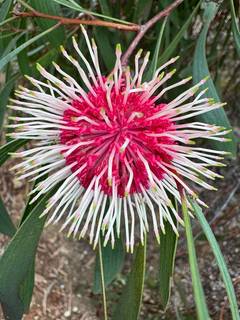
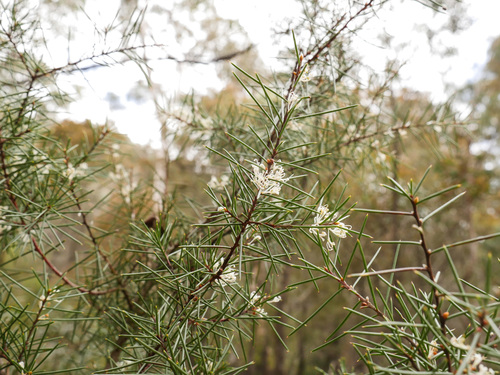
Hakea sericea is an evergreen shrub in the family Proteaceae reaching 6-13 feet (2-4 m) tall, with a dense, bushy framework of rigid branches. Leaves are needle-like, terete (cylindrical), 1-2 inches (2.5-5 cm) long, and end in a sharp, hard point. Small clusters of white to pale pink flowers, each about 0.2 inch (5 mm) across, form in the leaf axils through winter and into spring. The flowers are followed by woody, beaked seed capsules (follicles) 1-1.4 inches (2.5-3.5 cm) long that stay closed on the plant for years and release two winged seeds when the plant dies or is burnt. Growth is moderate to fast. The sharp needle leaves make the plant difficult to handle, and the species seeds heavily; outside its native range it is a serious environmental weed that forms dense, impenetrable thickets.
Native Range
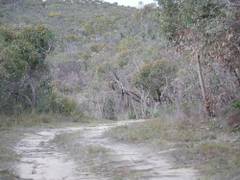
Native to southeastern Australia, in New South Wales, Victoria, and Tasmania. Grows in heathland and dry sclerophyll forest on well-drained sandy and rocky soils. Beyond Australia it is naturalised and listed as an invasive weed in South Africa, Portugal, Spain, and New Zealand, where it invades fire-prone shrublands.Suggested Uses
Grown in native gardens as a prickly barrier or screen and for bird habitat, spaced 5-8 feet (1.5-2.4 m) apart, where the dense thorny growth blocks access. The persistent seed capsules and bird-attracting flowers add seasonal interest. Heavy seeding and weed status limit its planting near natural bushland and in regions where it has naturalised.How to Identify
Appearance
Size & Dimensions
Height6' - 13'
Width/Spread5' - 10'
Bloom Information
Flowers from late autumn through winter and into spring, mainly May to September. Flowering lasts several weeks, with small cream to pink clusters scattered along the branches. The flowers draw nectar-feeding birds and insects. Seed capsules develop after flowering and remain closed on the plant for years.
Detailed Descriptions
Flower Description
white to pale pinkFoliage Description
greenGrowing Conditions
Sun Requirements
Requires 6-12 hours of direct sunlight daily
• Full Sun: 6+ hours of direct sunlight
• Partial Shade: 3-6 hours of direct sunlight
• Full Shade: Less than 3 hours of direct sunlight
Care & Maintenance
Care Guide
Grows in well-drained sandy or rocky soil in full sun, tolerating poor, low-nutrient ground and dry conditions once established. Water through the first season; mature plants survive on rainfall. As a member of Proteaceae it is sensitive to phosphorus, and phosphorus-rich fertilisers can kill it. The species seeds heavily and can spread into surrounding bushland, which is why it is treated as a weed in many countries. Root-rot fungi cause dieback in poorly drained soils.Pruning
Prune after flowering to shape the bush and limit size. Plants reshoot from older wood after moderate cutting. Removing seed capsules before they open reduces unwanted spread. The sharp needle foliage slows pruning work.Pruning Schedule
Prune: October–November
spring