Gunnera, Genus, spp., Multiple species,
- Genus
- Multiple species
gunneras
Southern Hemisphere; South America, southern Africa, Australasia, Pacific islands
Overview
Gunnera is a genus of about 60 species in its own family (Gunneraceae), ranging from ground-hugging mats only a few inches tall to giant clump-formers whose single leaves can span 3-6 ft (0.9-1.8 m). In the large species, such as G. manicata and G. tinctoria, the rounded, deeply lobed leaves are carried on prickly stalks 5-8 ft (1.5-2.4 m) tall and die back to a crown each winter. At the other extreme, G. magellanica forms creeping mats under 4 in (10 cm) high with kidney-shaped leaves about 1 in (2.5 cm) wide. Tiny flowers are packed onto dense, cone-like or branched spikes up to 3 ft (90 cm) tall in the large species, ripening to small reddish fruits. The roots host symbiotic cyanobacteria that fix nitrogen, supporting growth in poor, wet ground. The genus is native to the Southern Hemisphere, with species in South America, southern Africa, Australasia, and Pacific islands, chiefly in bogs, stream banks, and damp forest. Large species need constant soil moisture and shelter from wind, and their crowns are frost-sensitive, dying in hard freezes without winter cover. G. tinctoria has naturalised and is classed as invasive in Ireland and parts of the Pacific Northwest.
Native Range
The genus is confined to the Southern Hemisphere, with species across South America, southern Africa, New Zealand, southeast Australia, Tasmania, and scattered Pacific islands. They grow in consistently wet ground, including bogs, stream margins, and damp forest floors.Suggested Uses
Large species are grown as bold foliage specimens beside ponds, lakes, and streams and in bog gardens. G. magellanica and other dwarfs are used as groundcover in consistently moist, shaded sites.How to Identify
Appearance
Size & Dimensions
Height3" - 8'
Width/Spread1' - 12'
Bloom Information
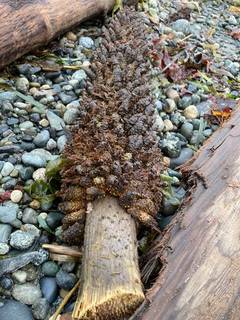
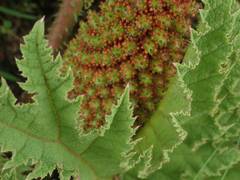
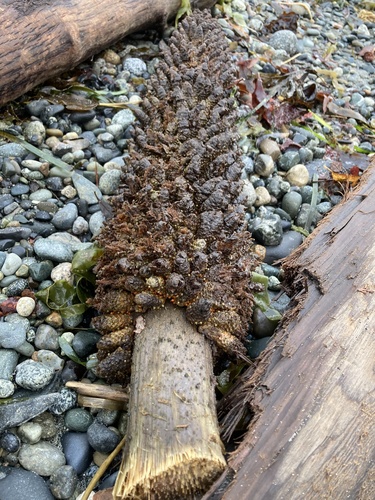
Flowering occurs in late spring and summer, when thick flower spikes emerge near the crown before or alongside the new leaves. The densely packed greenish to reddish flowers are followed by small red-orange fruits in late summer. In dwarf mat-forming species the spikes are short and partly hidden by foliage.
Detailed Descriptions
Flower Description
green to reddishFoliage Description
greenGrowing Conditions
Sun Requirements
Requires 4-8 hours of direct sunlight daily
• Full Sun: 6+ hours of direct sunlight
• Partial Shade: 3-6 hours of direct sunlight
• Full Shade: Less than 3 hours of direct sunlight
Care & Maintenance
Care Guide
Large species grow in full sun to part shade where soil stays wet year-round, including pond and stream margins and boggy ground. Rich, deep, organic soils support the broadest leaves, and growth falters where roots dry out. Dwarf species tolerate ordinary moist soil and fit rock-garden or groundcover use. Crowns of the large species are frost-sensitive and are covered through winter with their own cut leaves or other mulch in cold regions. Shelter from strong wind prevents tearing of the broad leaf blades. Nitrogen-fixing root symbionts reduce the need for feeding, though spring mulch sustains leaf size.Pruning
Frost-blackened leaves of the large species are cut down in autumn and laid over the crown as insulation through winter. Spent flower spikes can be removed once fruiting finishes to limit self-seeding, which is vigorous in G. tinctoria.Pruning Schedule
Prune: October–November
fall