Image 1 of 15
1 / 15
Plant Reference
Gunnera, Genus, manicata, Species,
- Genus & species
gunnera
Southern Brazil — the Serra do Mar coastal mountains of Santa Catarina and Rio Grande do Sul; humid forest margins, stream banks, and clearings at moderate elevations
Overview
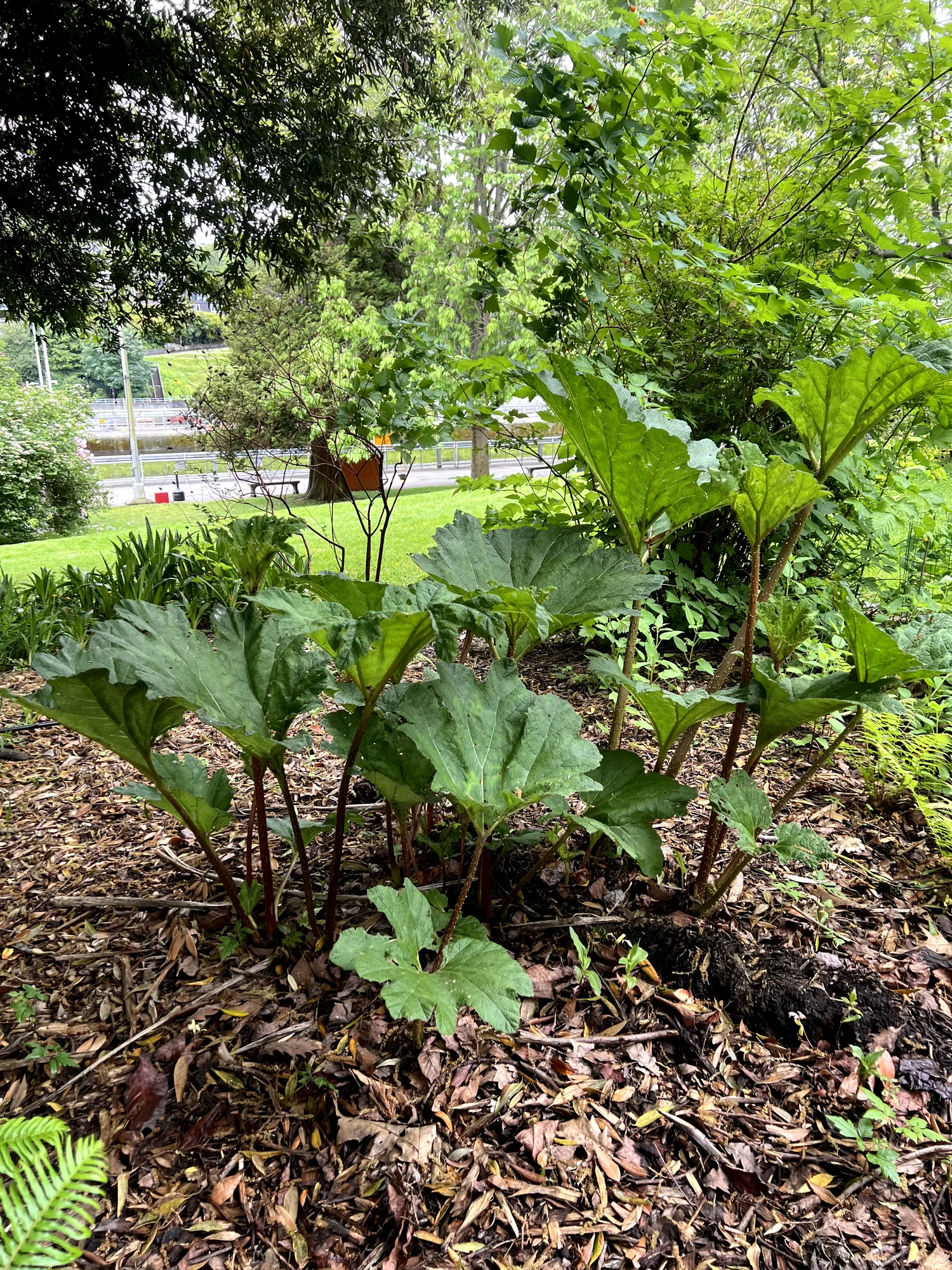
Gunnera manicata is a massive clumping deciduous perennial in the family Gunneraceae reaching 72–108 inches (180–270 cm) tall and 120–192 inches (300–490 cm) wide from a thick woody crown at ground level. Individual leaf blades reach 36–72 inches (90–180 cm) across at maturity — among the largest leaf blades of any herbaceous plant cultivated in temperate gardens — and are kidney-shaped to rounded in outline with prominently impressed veins and coarsely toothed margins. The leaves are supported on massively thick petioles 48–96 inches (120–240 cm) long that are covered in stout reddish prickles along the entire length and up to 2–3 inches (5–7 cm) in diameter at the base. Conical reddish-brown flower spikes 36–48 inches (90–120 cm) long emerge at ground level between the petioles in June and July, bearing thousands of tiny flowers followed by small orange-red berries in late summer. The species harbors endosymbiotic Nostoc cyanobacteria in specialized glands at the bases of the stems, and the cyanobacteria fix atmospheric nitrogen into a plant-available form — this symbiosis is found in no other flowering plant lineage and is one of the main reasons for the rapid growth rate of the species in moist positions. The common name Brazilian giant rhubarb references the superficial leaf resemblance to rhubarb (Rheum rhabarbarum) rather than any botanical relationship, and the two genera are in entirely different plant families separated by tens of millions of years of evolutionary history. Native to the coastal mountains of southern Brazil (Serra do Mar) in the states of Santa Catarina and Rio Grande do Sul, where the species grows along humid forest margins, stream banks, and clearings at moderate elevations. The leaf petioles have been consumed as a cooked vegetable in parts of the native range. Limitation: G. manicata calls for consistently wet to boggy soil along streambanks, pond margins, and bog garden edges, and the species fails on any dry position because the large leaves transpire substantial amounts of water that the root system needs to replace from the soil. Winter crown protection is required in USDA zones 7 and 8: after the first hard autumn frost kills the foliage, the dead leaves are cut partially at the petiole base and folded over the crown to form an insulating mound that holds the rootstock through winter freezes. The mature plant calls for 120–192 inches (300–490 cm) of horizontal space in every direction, which makes it unsuitable for residential lots smaller than about a quarter acre.
Native Range
Native to the coastal mountains of southern Brazil — primarily the Serra do Mar range in the states of Santa Catarina and Rio Grande do Sul. Grows along humid forest margins, stream banks, and clearings at moderate elevations in the subtropical rainforest belt, where the combination of consistent rainfall, mild temperatures, and rich organic soils suits the growth cycle and massive foliage of the species.Suggested Uses
Used as a specimen perennial at the edges of ponds, streams, bog gardens, lake margins, and rain garden low points in USDA zones 7 through 10 at 120–192 inch (300–490 cm) spacing from any companion planting. The massive leaves carry the species into the category of landscape focal plants typically reserved for woody trees, and the species is often paired with other large-leaved moisture-loving perennials such as Rodgersia pinnata, Ligularia dentata, and Lysichiton americanus at water-feature plantings. Residential lots smaller than about a quarter acre, dry border positions, and gardens in USDA zones colder than zone 7 are unsuitable because of the mature size of the plant, the consistent moisture requirement, and the winter cold sensitivity of the crown.How to Identify
Appearance
Size & Dimensions
Height6' - 9'
Width/Spread10' - 16'
Bloom Information
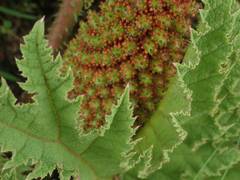
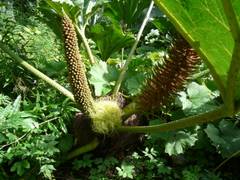
Conical reddish-brown flower spikes 36–48 inches (90–120 cm) long emerge at ground level between the petioles in June and July across about 6 weeks. Each spike bears thousands of tiny flowers followed by small orange-red berries that ripen in late summer. The massive foliage — not the flower spikes — is the main ornamental feature of the species, and the flowers are often overlooked or hidden beneath the leaf canopy because they remain at ground level throughout the bloom period.
Detailed Descriptions
Flower Description
reddish-brown tiny flowers borne on conical flower spikes 36-48 inches (90-120 cm) long at ground level between the petioles; followed by small orange-red berriesFoliage Description
dark green; kidney-shaped to rounded leaf blades 36-72 inches (90-180 cm) across with prominently impressed veins and coarsely toothed margins; carried on massively thick petioles 48-96 inches (120-240 cm) long that are covered in stout reddish pricklesGrowing Conditions
Sun Requirements
Requires 4-8 hours of direct sunlight daily
• Full Sun: 6+ hours of direct sunlight
• Partial Shade: 3-6 hours of direct sunlight
• Full Shade: Less than 3 hours of direct sunlight
Care & Maintenance
Care Guide
Site in part sun to full sun with 4–8 hours of direct sun per day in consistently wet to boggy soil with a pH of 5.5–7.0. Suitable positions include streambanks, pond margins, bog garden edges, and rain garden low points where the soil stays saturated through the summer growing season. The species fails on dry positions because the massive leaves transpire substantial amounts of water that the root system needs to replace from the soil, and supplemental irrigation is a poor substitute for a naturally wet site. Plant spacing calls for 120–192 inches (300–490 cm) of horizontal room in every direction. Winter crown protection is required in USDA zones 7 and 8: after the first hard autumn frost kills the foliage, the dead leaves are cut partially at the petiole base and folded over the crown to form an insulating mound that protects the rootstock through winter freezes; the mound is removed in early spring before new growth emerges. Compost mulch is applied in autumn to enrich the soil for the following year's growth, and a spring fertilizer application supports the rapid leaf expansion from May through July. The species is non-toxic and deer-resistant. Hardy in USDA zones 7–10.Pruning
After the first hard autumn frost kills the foliage in October or November, the leaves are cut partially at the petiole base and folded or piled over the crown to form an insulating mound for winter protection in zones 7 and 8. The protective mound is removed in early spring (March) before new growth emerges, and any remaining dead material is cut to the ground at that time. Spent flower spikes can be removed at the base if self-seeding is not desired, or left to shed the small orange-red berries for natural seedling establishment in suitable wet positions. No other pruning is needed because the foliage regenerates entirely from the crown each spring.Pruning Schedule
Prune: March & October–November
fallearly spring