Gomphocarpus, Genus, spp., Multiple species,
- Genus
- Multiple species
milkweed
Overview
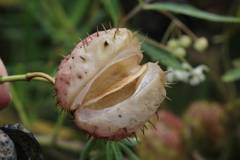
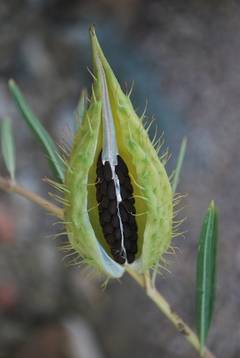
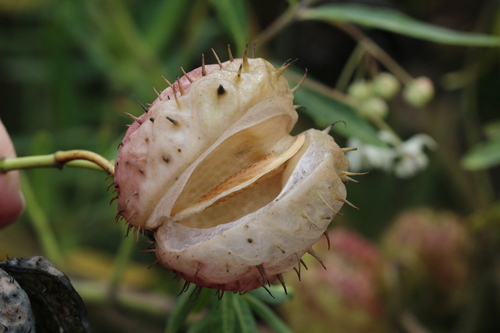
Gomphocarpus is a genus of about 20 species of evergreen subshrubs and perennial herbs in the milkweed family (Apocynaceae), native to Africa and the Arabian Peninsula and naturalised across Australia, the Americas, and Pacific islands. Plants reach 3–6.5 ft (0.9–2 m) tall and 2–3 ft (60–90 cm) wide, with erect, sparingly branched stems that exude milky latex when cut. The narrow, lance-shaped to linear leaves measure 2–5 in (5–13 cm) long and sit opposite or in whorls along the stems. Cream to greenish-white flowers, each 0.3–0.4 in (8–10 mm) across, form in nodding clusters of 5–12 from late spring through autumn; five reflexed petals surround a raised central corona. Pollinated flowers develop into inflated, bladder-like follicles 1.5–3 in (4–8 cm) long covered in soft bristles, which split to release flat brown seeds bearing tufts of silky white hairs. All parts contain cardenolide toxins, and the milky sap irritates skin and eyes. The genus is a larval food source for monarch and lesser wanderer butterflies. In several regions, including parts of Australia and Hawaii, G. fruticosus and G. physocarpus are recorded as environmental weeds that colonise pasture and disturbed ground.
Native Range
Native to tropical and southern Africa and the Arabian Peninsula, with the centre of diversity in southern Africa. Several species have naturalised widely in Australia, the Americas, and on Pacific islands, where they grow on roadsides, pasture, and disturbed ground.Suggested Uses
Grown in butterfly and wildlife gardens as a larval host for monarch butterflies, and in informal borders and dry gardens. The inflated seed pods are used in cut and dried floral arrangements. It is unsuited to areas where it is recorded as an environmental weed.How to Identify
Appearance
Size & Dimensions
Height3' - 6'6"
Width/Spread2' - 3'
Bloom Information
Flowers appear from late spring through autumn, around November to April in the southern hemisphere and June to October in the northern, with peak bloom in summer. Individual umbels open over several weeks, and flowering often overlaps with the development of the inflated follicles. In frost-free climates scattered flowers can appear for much of the year.
Detailed Descriptions
Flower Description
Cream to greenish-whiteFoliage Description
Green to grey-greenGrowing Conditions
Sun Requirements
Requires 6-10 hours of direct sunlight daily
• Full Sun: 6+ hours of direct sunlight
• Partial Shade: 3-6 hours of direct sunlight
• Full Shade: Less than 3 hours of direct sunlight
Care & Maintenance
Care Guide
Most species grow in full sun and free-draining sandy or loamy soils, tolerating poor fertility and extended dry periods once established. A sheltered, warm position suits the genus; growth slows below 50°F (10°C), and frost cuts back top growth. Moderate water aids establishment, after which plants draw on deep roots through drought. Plants are short-lived, often persisting 2–4 years, but self-seed freely from wind-borne seed. All parts are toxic if eaten, and the milky sap can irritate skin and eyes. Cut stems release latex that stains and clings to tools.Pruning
Little pruning is needed. Spent stems and seed pods can be cut back in late winter to limit self-seeding and to remove frost-damaged growth. Cutting releases milky latex that can irritate skin.Pruning Schedule
winter
Container Growing
Suitable for container growing
Minimum container size: 3 gallons