Overview
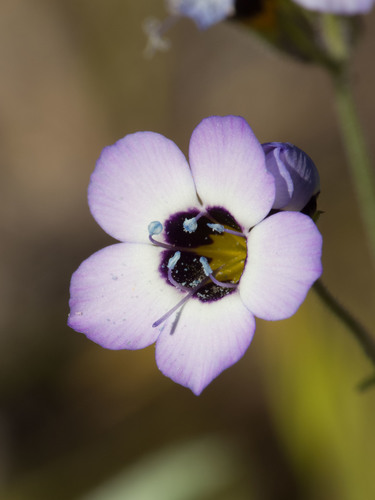
Gilia tricolor is an annual wildflower growing 4-20 inches (10-50 cm) tall on slender, branching stems. The lower leaves are finely divided into narrow segments 0.5-1.5 inches (1-4 cm) long, forming a loose basal cluster that thins toward the upper stem. Flowers are funnel-shaped, about 0.5 inch (1.2 cm) across, carried singly or in small clusters at the branch tips. Each flower shows three colour zones: pale violet to lavender outer lobes, a yellow throat, and five dark purple to maroon marks ringing the throat opening, with blue pollen on the anthers. Plants flower from March to May in their native range and self-sow where soil is left undisturbed. The species germinates with autumn and winter rains, growing as a low rosette before flowering in spring. It occupies open grassland, valley floors, and foothill slopes below 5,000 feet (1,500 m). The flowers carry a scent often compared to chocolate, strongest on warm afternoons. A limitation in the garden is its short life: plants complete their cycle and die by early summer, leaving gaps unless reseeding is allowed.
Native Range
Gilia tricolor is native to California, where it grows in the Central Valley, surrounding foothills, and inner Coast Ranges. Its range extends into the foothills of the Sierra Nevada and parts of southern Oregon.Suggested Uses
Used in wildflower meadows, native plant gardens, and seed mixes for spring colour. Suited to rock gardens and the front of borders, spaced 6-9 inches (15-23 cm) apart. The nectar and pollen draw native bees, hoverflies, and small butterflies.How to Identify
Appearance
Size & Dimensions
Height4" - 1'8"
Width/Spread4" - 8"
Bloom Information
Flowers open from March through May, peaking in April across most of the native range. Bloom begins earlier in warm lowland sites and later at higher elevations. Individual plants flower for several weeks before setting seed and dying back.
Detailed Descriptions
Flower Description
lavender with yellow throat and purple markingsFoliage Description
greenGrowing Conditions
Sun Requirements
Requires 6-12 hours of direct sunlight daily
• Full Sun: 6+ hours of direct sunlight
• Partial Shade: 3-6 hours of direct sunlight
• Full Shade: Less than 3 hours of direct sunlight
Water & Climate
Water Needs
Drought Tolerance
Drought tolerant when established
Care & Maintenance
Care Guide
Gilia tricolor grows in full sun and sandy, loam, or gravelly soils with sharp drainage. Seed is sown in autumn where winter rains germinate it, or in early spring in colder regions; growth is strongest in cool weather and declines in summer heat. Plants need little supplemental water once rains establish them and tolerate seasonal drought as they mature. Overly rich or wet soil produces lank growth and fewer flowers. The species reseeds freely, returning each year from self-sown seed where the ground is not heavily cultivated.Pruning
No pruning is required. Spent plants can be pulled once seed has set, though leaving them in place allows self-sowing for the following season. Light shearing after the first flush sometimes prolongs flowering in cool conditions.Container Growing
Suitable for container growing
Minimum container size: 1 gallons
Toxicity
Non-toxicPlanting Guide
Planting Methods & Timing
Planting Method
direct sow
Direct Sow Timing
fall or early spring
Days to Maturity
60–90 days
Plant Spacing
8 inches