Frullania, Genus, eboracensis, Species,
- Genus & species
New York scalewort
SunFull Shade – Part Shade
Overview
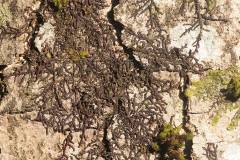
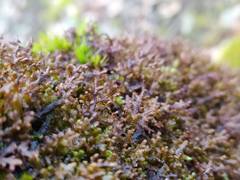
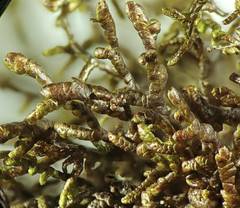
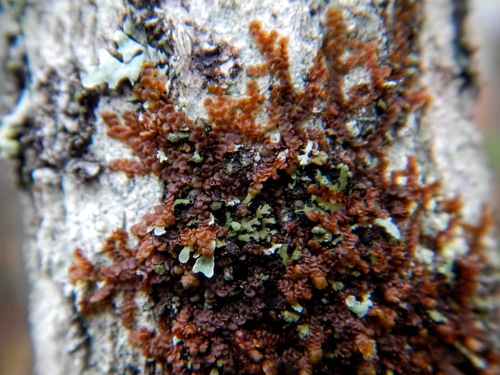
Frullania eboracensis is a small leafy liverwort that forms thin, closely appressed mats on tree bark and occasionally shaded rock. The slender, irregularly pinnate shoots are typically 0.4-1.2 inches (1-3 cm) long and well under 0.04 inch (1 mm) wide, ranging from olive-green to reddish-brown or nearly black depending on light exposure. As in all Frullania, the leaves are arranged in three ranks and are incubous, with each lateral leaf divided into a rounded upper lobe and a modified lower lobe shaped into a tiny helmet-like sac that holds water. Pointed underleaves run along the underside of the stem. Reproduction is by spores released from reddish capsules raised on short, translucent stalks, and by vegetative fragmentation. The plant has no roots, drawing moisture and minerals directly across its surface, and no vascular tissue, flowers, or seeds. It tolerates repeated drying and rehydrates when wetted. One challenge in identification is its resemblance to other bark-dwelling Frullania, which often requires magnification of the lobules and underleaves to confirm.
Native Range
Frullania eboracensis is native to eastern North America, ranging from southeastern Canada south through the eastern United States. It grows most commonly in deciduous and mixed forests where humid air and stable bark surfaces are available.Suggested Uses
This liverwort is not grown horticulturally and is encountered as a natural epiphyte on forest trees. In a reference context it represents the leafy liverworts and the Frullania growth form. Its sensitivity to pollution gives it value in air-quality monitoring studies.How to Identify
Growing Conditions
Sun Requirements
Tolerates up to 4 hours of direct sunlight daily
• Full Sun: 6+ hours of direct sunlight
• Partial Shade: 3-6 hours of direct sunlight
• Full Shade: Less than 3 hours of direct sunlight
Water & Climate
Water Needs
Drought Tolerance
Drought tolerant when established