Freesia, Genus, spp., Multiple species,
- Genus
- Multiple species
freesia
Overview
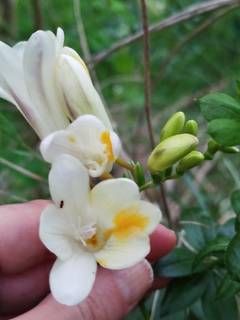
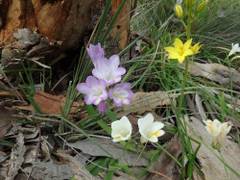
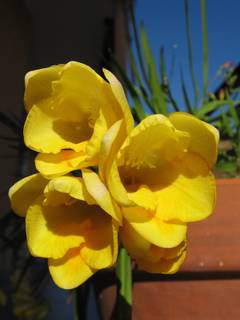
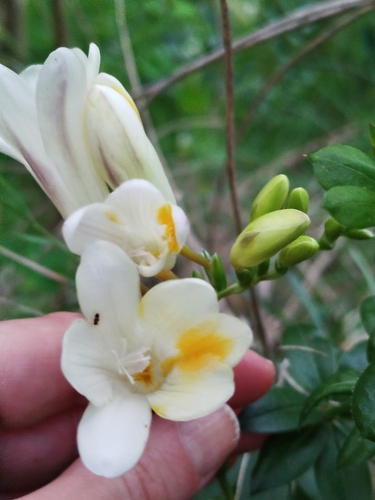
Freesia is a genus of about 16 species of cormous perennials in the iris family (Iridaceae), native to southern Africa, with most species from the winter-rainfall regions of the Cape in South Africa. Plants grow from a small corm, producing a fan of narrow, sword-shaped leaves 4-12 inches (10-30 cm) long and wiry, branched flowering stems 12-18 inches (30-45 cm) tall. The stem bends near the top so that the funnel-shaped flowers are held in a one-sided, upward-facing row. Flowers come in white, yellow, cream, pink, red, orange, mauve, and purple, often with contrasting throats, and many are strongly and sweetly fragrant. In their native climate they grow and flower in the cool, moist winter and spring, then die back to the corm and rest through the dry summer. Freesia is grown worldwide for cut flowers and as a fragrant pot and garden bulb, but it is frost-tender, hardy only in mild, nearly frost-free regions, and elsewhere is lifted or grown under glass. Modern garden freesias are largely hybrids derived from several species.
Native Range
Freesia is native to southern Africa, with its center of diversity in the winter-rainfall Cape region of South Africa, and a few species extending into tropical Africa. It is not native to North America.Suggested Uses
Freesia is grown for fragrant cut flowers, in pots and forced for indoor bloom, and in beds and borders in mild, nearly frost-free climates. The corms are planted in drifts in rock gardens and sunny borders where winters are gentle. In colder regions plants are grown in containers and moved under cover, or treated as lifted bulbs.How to Identify
Appearance
Size & Dimensions
Height1' - 1'6"
Width/Spread4" - 6"
Colors
Bloom Information
In mild climates flowering occurs in late winter and spring, roughly February to April, while forced and greenhouse plants bloom at other times of year. The fragrant funnel-shaped flowers open in sequence up the one-sided spike over two to three weeks. The flowers draw bees and long-tongued insects and are cut for their scent.
Detailed Descriptions
Flower Description
white, yellow, pink, red, orange, or purpleFoliage Description
greenGrowing Conditions
Sun Requirements
Requires 5-10 hours of direct sunlight daily
• Full Sun: 6+ hours of direct sunlight
• Partial Shade: 3-6 hours of direct sunlight
• Full Shade: Less than 3 hours of direct sunlight
Care & Maintenance
Care Guide
Freesia grows in full sun to light shade in free-draining, sandy or loamy soil, and follows a winter-growing, summer-dormant cycle. Corms are planted in autumn in mild regions for spring bloom, or potted and grown cool indoors elsewhere, since the plants are frost-tender. They need steady moisture during growth and flowering and a dry rest after the leaves yellow. Cool nights around 40-55°F (4-13°C) during growth give the heaviest flowering, while heat shortens bloom and causes weak, floppy stems. Corms are lifted and stored dry over summer in regions with wet summers or hard winters. Mild fungal rots can affect corms in cold, wet soil.Pruning
Faded flowers are removed to keep plants tidy, and the flower stem is cut back once all the blooms have passed. Leaves are left to die down naturally after bloom, as they rebuild the corm for the next season. The foliage is cut away only once it has yellowed and dried.Container Growing
Suitable for container growing
Minimum container size: 1 gallons