Fothergilla, Genus, major, Species,
- Genus & species
Large fothergilla
Southeastern United States (Appalachian region)
Overview
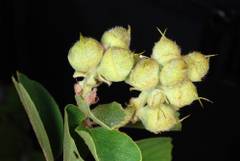
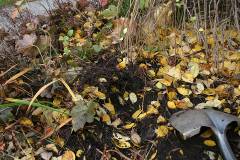
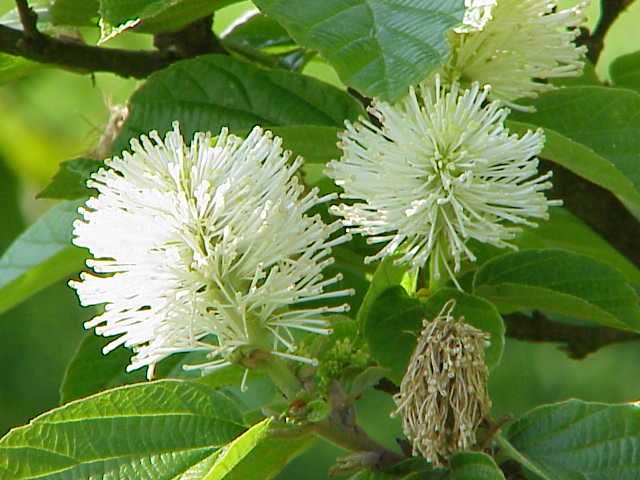
Fothergilla major is a deciduous, multi-stemmed shrub in the witch hazel family (Hamamelidaceae), growing 6–10 feet (1.8–3 m) tall and 5–9 feet (1.5–2.7 m) wide at a rate of 6–12 inches (15–30 cm) per year. Stems are upright and spreading, with gray-brown bark and zigzag twigs. Leaves are broadly oval to obovate, 2–4 inches (5–10 cm) long, with shallowly toothed upper margins, a dull dark green upper surface, and a blue-green, hairy underside. Flowers lack petals and appear as dense, bottlebrush-like spikes 1–2 inches (2.5–5 cm) long in April–May before and with the emerging leaves, formed by white stamens 0.5 inch (13 mm) long and a honey-like scent. Fruits are woody capsules 0.5 inch (13 mm) long that split to release shiny black seeds in late summer. Fall foliage ranges from yellow to orange and red-purple, with colors varying by plant and light exposure. Plants need acidic soil, and leaves yellow with iron chlorosis at pH above 6.5. Roots are shallow and sensitive to drought and soil compaction. Suckers form slowly, producing wider clumps over 10–15 years.
Native Range
Fothergilla major is native to the southeastern United States, where it grows in the Appalachian Mountains and adjacent upland forests, typically in acidic, moist, well-drained soils in open woodland and on rocky slopes. The genus Fothergilla contains only two species, both native to the southeastern United States.Suggested Uses
Used in woodland gardens, foundation plantings, and shrub borders, spaced 5–8 feet (1.5–2.4 m) apart. Flowers are visited by bees and early-season butterflies in spring, and plants are used in mass plantings where autumn color is displayed against evergreen backgrounds.How to Identify
Appearance
Size & Dimensions
Height6' - 10'
Width/Spread5' - 9'
Bloom Information
Flowers open in April to May for 2–3 weeks, beginning before leaves expand. Spikes of white stamens 1–2 inches (2.5–5 cm) long carry a honey-like fragrance noticeable at 10–15 feet (3–4.5 m). Seed capsules mature from July to September and open explosively.
Detailed Descriptions
Foliage Description
Dull dark green above, blue-green beneathGrowing Conditions
Sun Requirements
Requires 4-10 hours of direct sunlight daily
• Full Sun: 6+ hours of direct sunlight
• Partial Shade: 3-6 hours of direct sunlight
• Full Shade: Less than 3 hours of direct sunlight
Care & Maintenance
Care Guide
Grows in full sun to part shade in moist, well-drained, acidic soil with a pH of 5.0–6.0, and autumn leaf color develops with at least 4–6 hours of direct sun. Hardy in USDA zones 4–8. Plants receive 1 inch (2.5 cm) of water per week, because shallow roots are sensitive to drought. Mulch 2–3 inches (5–7.5 cm) deep keeps roots cool and moist. Alkaline soil above pH 6.5 causes iron chlorosis, and plants establish slowly after transplanting. Pests and diseases are few, with occasional leaf spot and scale in stressed plants.Pruning
Pruning is limited to removal of dead or crossing stems immediately after flowering in May–June, because flower buds form the previous summer. Up to one-third of the oldest stems are cut to the ground every 3–4 years to renew the shrub. Cuts made after July remove the next season's flower buds.Pruning Schedule
Prune: May–June
late springsummer