1 / 10
© Martin Dovciak, some rights reserved (CC-BY-NC) · iNaturalist
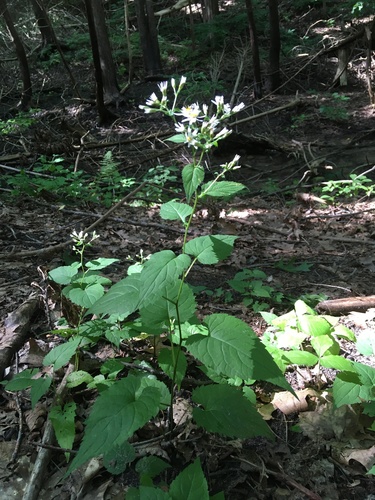
Eurybia divaricata
White Wood Aster
Eastern North America (Quebec to Georgia)
Learn more
Overview
Eurybia divaricata (syn. Aster divaricatus) is a clump-forming herbaceous perennial reaching 12–24 inches (30–60 cm) tall with a spread of 18–24 inches (45–60 cm). Stems are wiry, dark brown to nearly black, and zigzag between leaf nodes. Leaves are heart-shaped at the base, 2–5 inches (5–13 cm) long, coarsely toothed, medium green, becoming smaller and narrower toward the stem tips. Flat-topped clusters of small, white, daisy-like flower heads, each 0.7–1 inch (1.8–2.5 cm) across with 6–10 white ray florets and a yellow central disc that ages to reddish-brown, appear at the stem tips in August–October. The dark stems and open, airy flower clusters create a layered canopy effect. The plant spreads by short rhizomes, forming loose colonies 3–6 inches (8–15 cm) per year. Foliage develops powdery mildew on lower leaves in humid conditions with poor air circulation, particularly by late summer. In deep shade, stems elongate and may flop without support from neighboring plants. The plant tolerates dry shade better than most asters, though extended drought causes premature leaf drop from the lower stems.
Native Range
Eurybia divaricata is native to eastern North America, from Quebec and Ontario south to Georgia and Alabama. It occurs in dry to moist deciduous forests, woodland edges, and shaded rocky slopes from near sea level to 5,000 feet (1,500 m) elevation.Suggested Uses
Planted in woodland gardens, shaded borders, and dry shade areas at 18–24 inch (45–60 cm) spacing. The dark stems and white flowers contrast with the green foliage of ferns and hostas in late-season shade compositions. Suitable for naturalizing in dry deciduous woodland where other perennials fail. Not commonly grown in containers due to the rhizomatous spread.How to Identify
Appearance
Size & Dimensions
Height1' - 2'
Width/Spread1'6" - 2'
Reaches mature size in approximately 3 years
Bloom Information
White flower heads appear in flat-topped clusters in August–October. Individual flower heads are 0.7–1 inch (1.8–2.5 cm) across with 6–10 white ray florets. The yellow disc centers age to reddish-brown over 1–2 weeks. Bloom duration is 4–6 weeks. Seed heads persist on the dark stems through fall and into winter.Detailed Descriptions
Flower Description
White with yellow disc aging to reddish-brownFoliage Description
Medium green, heart-shaped at baseGrowing Conditions
Sun Requirements
Requires 2-5 hours of direct sunlight daily
• Full Sun: 6+ hours of direct sunlight
• Partial Shade: 3-6 hours of direct sunlight
• Full Shade: Less than 3 hours of direct sunlight
Care & Maintenance
Care Guide
Plant in well-drained to average soil in partial shade to full shade. This species tolerates dry shade conditions that cause other asters to wilt or decline, though growth is more vigorous with consistent moisture. Powdery mildew develops on lower leaves in humid, poorly ventilated sites; affected foliage can be removed without harming the plant. In deep shade, stems elongate and lean toward light; pinching stem tips by one-third in early June reduces height and promotes bushier growth. Divide clumps every 3–4 years in spring when the center becomes sparse. Rabbits and deer browse emerging foliage in spring.Pruning
Pinch stem tips by one-third in early June to reduce final height by 4–6 inches (10–15 cm) and promote branching, which delays bloom by 1–2 weeks. Cut all stems to ground level in late fall or early spring. Mildewed lower foliage can be removed at any time during the growing season without affecting bloom.Pruning Schedule
J
F
M
A
M
J
J
A
S
O
N
D
summerfallearly spring