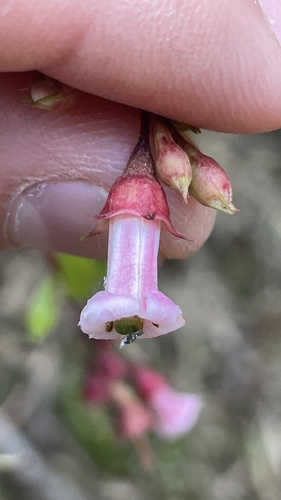
Escallonia, Genus, rubra, Species,
- Genus & species
redclaws
Overview
Escallonia rubra is an evergreen shrub 6-10 feet (1.8-3 m) tall and wide, occasionally taller, with dense, upright branching. The glossy dark green leaves are 1-3 inches (2.5-8 cm) long, finely toothed, and slightly resinous and aromatic when crushed. From early summer into autumn it carries branched clusters (panicles) of small tubular flowers, each about 0.5 inch (12 mm) long, in shades of red to deep pink. The flowers are visited by bees and other insects. Native to the coasts and hills of southern Chile and Argentina, it tolerates salt-laden wind and thin coastal soils, which makes it widely planted as a hedge and windbreak in mild maritime regions. It withstands hard clipping and regrows densely from old wood. The shrub is damaged by severe frost and is reliably hardy only in USDA zones 8 to 10, limiting its use in colder inland gardens. Growth is fast on free-draining soil in full sun. In heavy shade it becomes sparse and flowers little.
Native Range
Escallonia rubra is native to southern Chile and adjacent Argentina, where it grows on coastal slopes, scrub, and woodland margins in southern South America. Its natural range experiences mild, wet, maritime conditions.Suggested Uses
Widely used for evergreen hedges, screens, and windbreaks, especially in coastal and mild maritime gardens. It also works as a freestanding specimen or in mixed shrub borders. Its size and frost sensitivity make it less suitable for small or cold inland gardens.How to Identify
Appearance
Size & Dimensions
Height6' - 10'
Width/Spread6' - 10'
Bloom Information
Branched clusters of small red to pink tubular flowers open from June to September, sometimes into October in mild areas. Each flower is about 0.5 inch (12 mm) long and draws bees. Light trimming after the main flush can bring a second, smaller flowering.
Detailed Descriptions
Flower Description
Red to pinkFoliage Description
Glossy dark greenGrowing Conditions
Sun Requirements
Requires 6-10 hours of direct sunlight daily
• Full Sun: 6+ hours of direct sunlight
• Partial Shade: 3-6 hours of direct sunlight
• Full Shade: Less than 3 hours of direct sunlight
Care & Maintenance
Care Guide
Escallonia rubra grows in full sun on free-draining soil and tolerates a wide range of soil types, including sandy and chalky ground. Once established it withstands coastal salt spray, wind, and short dry spells, which suits it to seaside planting. It is hardy in USDA zones 8 to 10 and may be cut back or killed by hard frost in colder areas. Shelter from cold drying winds improves performance inland. Watering is needed in the first seasons and during prolonged drought. It responds well to feeding in spring on poor soils.Pruning
Trim hedges and shape shrubs immediately after the main flowering, usually in mid to late summer, so the next season's flower buds have time to form. Overgrown plants can be cut hard back into old wood, from which they regrow freely. Late-autumn trimming produces soft regrowth that is easily damaged by frost.Pruning Schedule
Prune: July–August
summer


