Erythronium, Genus, americanum, Species,
- Genus & species
yellow trout lily
{Erythronium americanum} is native to eastern North America, from Nova Scotia south to Georgia and west to Minnesota and Arkansas; the species grows in rich moist deciduous forests, floodplain woodlands, and shaded stream banks, often forming large colonies on the forest floor; the spring ephemeral life cycle takes advantage of the brief window of sunlight on the forest floor before the deciduous tree canopy closes overhead in late spring
Overview
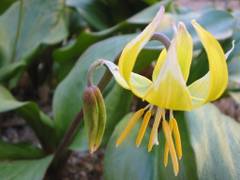
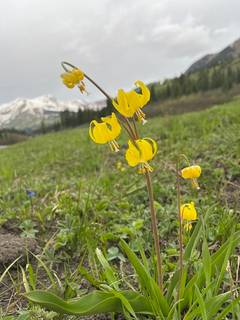
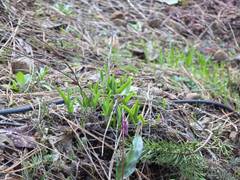
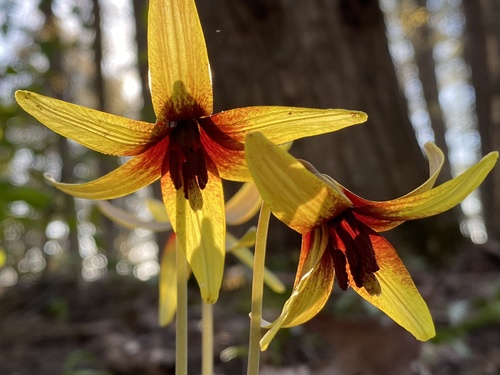
Erythronium americanum is a spring ephemeral wildflower growing from a small deep tooth-shaped corm 4-10 inches (10-25 cm) tall. A single pair of mottled brown-and-green glossy elliptic basal leaves appears in early spring, and on mature plants, a solitary nodding bright yellow lily flower with strongly recurved petals rises on a bare stem between the two leaves in March through May (timing varies by latitude and elevation). The common name trout lily references the brown-mottled leaf pattern that resembles the markings on a brook trout. The entire above-ground plant — leaves, flower, and stem — completes its annual cycle and disappears by late spring, going fully dormant before the deciduous canopy overhead fully leafs out. This spring ephemeral strategy takes advantage of the brief window of sunlight on the forest floor before the tree canopy closes. The tooth-shaped corms grow 4-8 inches (10-20 cm) deep and produce daughter corms by stolon-like droppers, gradually forming large colonies of non-flowering single-leaf plants with scattered flowering two-leaf plants. A colony may take 5-7 years to produce its first flowers from seed or newly planted corms. This slow establishment is the primary limitation — patience is essential. Once established, colonies are extremely long-lived and essentially permanent. Deer generally avoid the foliage, though some browsing may occur.
Native Range
Erythronium americanum is native to eastern North America, from Nova Scotia south to Georgia and west to Minnesota and Arkansas. It grows in rich moist deciduous forests, floodplain woodlands, and shaded stream banks, often forming large colonies on the forest floor.Suggested Uses
Used in woodland wildflower gardens under deciduous canopy, along shaded stream banks, and in naturalistic plantings where the spring ephemeral cycle is observed each year. The mottled foliage and yellow flowers are a signature of the eastern deciduous forest floor in early spring. Plant in large groups (25+) for a colony effect. Not suited to formal borders, containers, or any situation where the summer-through-winter dormancy leaves a visible gap.How to Identify
Appearance
Size & Dimensions
Height4" - 10"
Width/Spread4" - 8"
Bloom Information
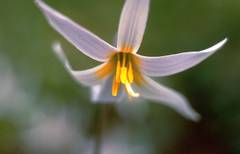
Flowering in March through May (latitude-dependent), approximately 2 weeks. A single nodding yellow flower per mature two-leaved plant. Many colony members are non-flowering single-leaf juveniles. The entire plant disappears by late spring.
Detailed Descriptions
Flower Description
Bright yellow nodding lily flowers with strongly recurved petals carried on a bare stem between the two basal leaves on mature plantsFoliage Description
Mottled brown-and-green elliptic glossy leaves; the brown-mottled pattern resembles the markings on a brook trout (the source of the common name) and serves as the diagnostic identification featureGrowing Conditions
Sun Requirements
Requires 2-5 hours of direct sunlight daily
• Full Sun: 6+ hours of direct sunlight
• Partial Shade: 3-6 hours of direct sunlight
• Full Shade: Less than 3 hours of direct sunlight