Epipactis, Genus, spp., Multiple species,
- Genus
- Multiple species
helleborines
Eurasia, North Africa, North America
Overview
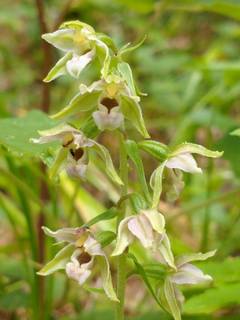
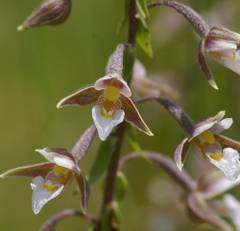
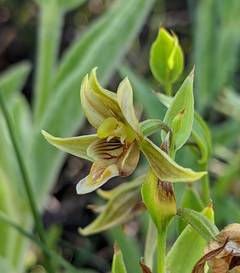
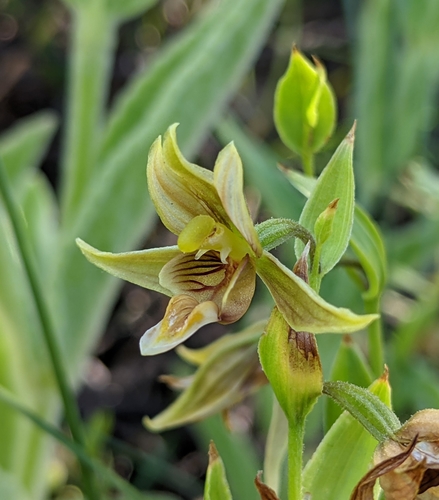
Epipactis is a genus of about 70 terrestrial orchids in the family Orchidaceae, found across temperate and subtropical regions of Eurasia, North Africa, and North America. Plants grow from creeping rhizomes and send up leafy stems 8–40 in (20–100 cm) tall, depending on species and conditions. The alternate leaves are oval to lance-shaped, strongly ribbed, and arranged in two ranks or spirally up the stem, mid-green and often tinged purple at the base. From early summer to autumn, a one-sided or spiralled spike carries numerous nodding flowers, each 0.4–0.8 in (1–2 cm) across, in muted shades of green, brown, pink, and dull purple. The flowers have a cup-shaped lip divided into a nectar-holding hypochile and a triangular epichile that guides pollinating wasps and bees. Some species, such as E. helleborine, are widespread and grow in woodland, dunes, and disturbed ground, while others are restricted to fens, seeps, and damp calcareous soils. A few, including E. gigantea of western North America, spread into broad colonies by rhizome. Most species need cool, moist, humus-rich ground in partial shade and are slow to establish, recovering slowly from disturbance to their root systems.
Native Range
Epipactis ranges across Europe, temperate Asia to Japan, North Africa, and North America, with the greatest concentration of species around the Mediterranean and southwest Asia. Habitats include deciduous woodland, fen margins, dune slacks, streambanks, and roadside verges, often over limestone. E. helleborine has naturalised across North America beyond its Eurasian range.Suggested Uses
Epipactis is grown in woodland gardens, shaded borders, and bog or streamside plantings where soil stays cool and moist. The rhizome-spreading species such as E. gigantea form colonies for naturalising in damp ground. The genus suits collectors of hardy terrestrial orchids more than general bedding use.How to Identify
Appearance
Size & Dimensions
Height8" - 3'4"
Width/Spread8" - 1'6"
Bloom Information
Flowering spans early summer to early autumn, generally June to September, with exact timing varying by species and elevation. Each spike opens its nodding flowers from the base upward over two to four weeks. The blooms are pollinated chiefly by wasps and bees drawn to nectar in the cupped lip.
Detailed Descriptions
Flower Description
green, brown, pink, and dull purpleFoliage Description
mid-green, often purple-tinged at the baseGrowing Conditions
Sun Requirements
Requires 2-6 hours of direct sunlight daily
• Full Sun: 6+ hours of direct sunlight
• Partial Shade: 3-6 hours of direct sunlight
• Full Shade: Less than 3 hours of direct sunlight
Care & Maintenance
Care Guide
Epipactis needs cool, consistently moist, humus-rich soil in dappled to partial shade, conditions that mimic the woodland and fen edges where the genus grows wild. Most species do well in neutral to alkaline ground, though E. gigantea tolerates a wider range and grows in wet, gravelly seeps. Plants spread slowly from rhizomes and can take several years to settle and flower after transplanting. A mulch of leaf litter conserves moisture and feeds the surface roots. The orchids depend on soil fungi for nutrient uptake, so they become established only in undisturbed ground with intact fungal networks. Established colonies are long-lived where moisture and shade remain stable.Pruning
Pruning is limited to removing spent flower stems and old foliage. Stems are cut back to the base after the leaves yellow in autumn, returning nutrients to the rhizome. The dormant rhizomes are left undisturbed through winter.Pruning Schedule
Prune: October–November
fall