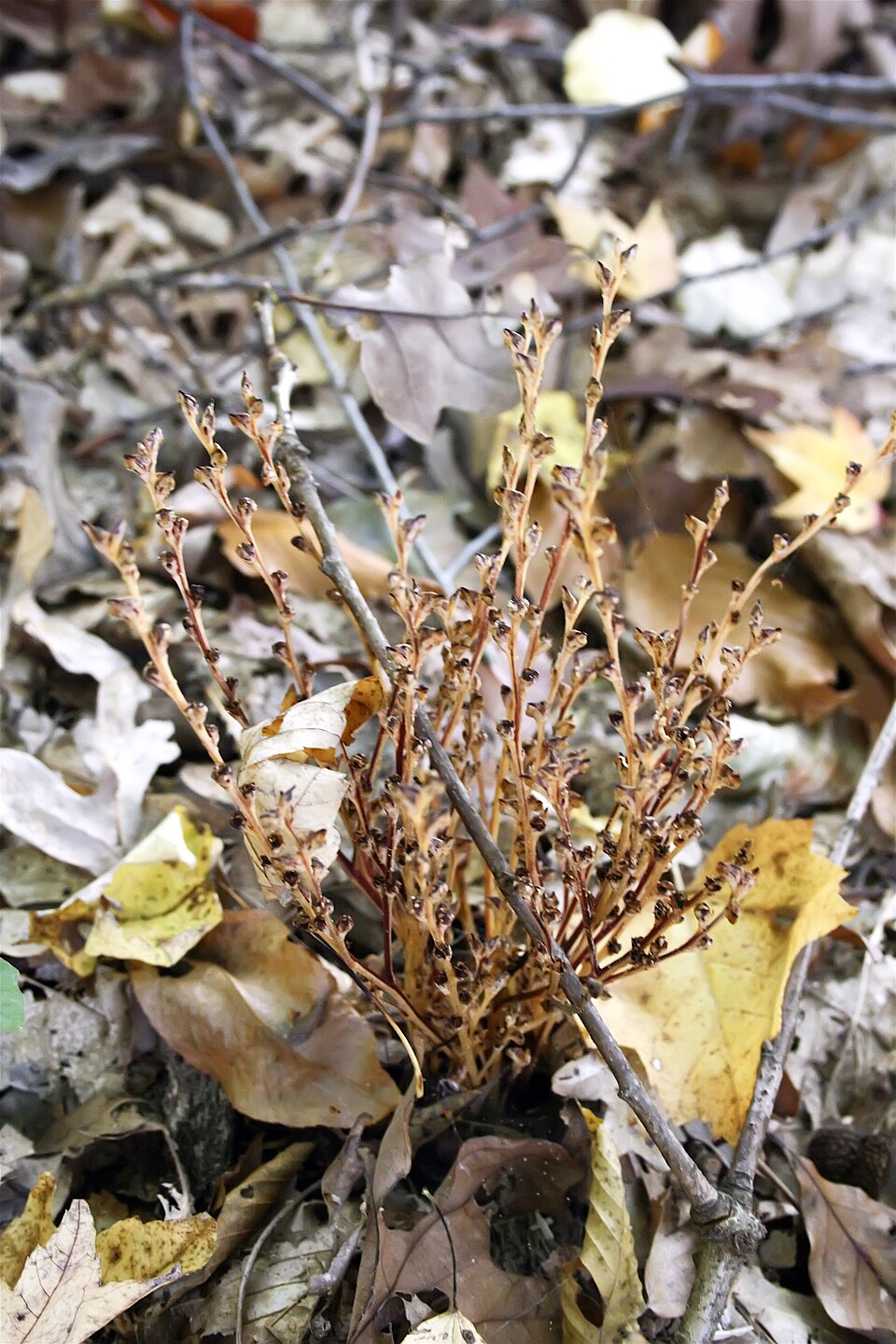
Overview
Epifagus is a genus in the broomrape family, Orobanchaceae, with the single species E. virginiana, beechdrops, an annual parasitic plant of eastern North American forests. It contains no chlorophyll and draws all its water and nutrients from the roots of American beech (Fagus grandifolia), to which it attaches by swollen underground connections. Above ground it appears as a branched, brownish to tan or purplish stalk 5 to 20 in (12 to 50 cm) tall, with only small scales in place of leaves. From late summer into autumn the slender stems carry tiny tubular flowers, whitish and striped with purple-brown, that are easy to overlook against the leaf litter. Because it depends entirely on a living beech host, the plant cannot be grown on its own and is never cultivated. It does the beech little apparent harm. Beechdrops is found only where beech grows, appearing among the roots beneath the canopy and dying back completely each year.
Native Range
Native to eastern North America, from southeastern Canada south through the eastern United States, wherever its host, American beech, grows in deciduous and mixed forest.Suggested Uses
Beechdrops has no horticultural use and is not planted in gardens. In the wild it is of interest to naturalists and botanists as an example of a parasitic flowering plant and as an indicator of established beech woodland. It is observed in place rather than grown.How to Identify
Appearance
Size & Dimensions
Height5" - 1'8"
Width/Spread3" - 10"
Bloom Information
Detailed Descriptions
Flower Description
Whitish with purple-brown stripesFoliage Description
Brown, no green leavesGrowing Conditions
Sun Requirements
Tolerates up to 3 hours of direct sunlight daily
• Full Sun: 6+ hours of direct sunlight
• Partial Shade: 3-6 hours of direct sunlight
• Full Shade: Less than 3 hours of direct sunlight
