Overview
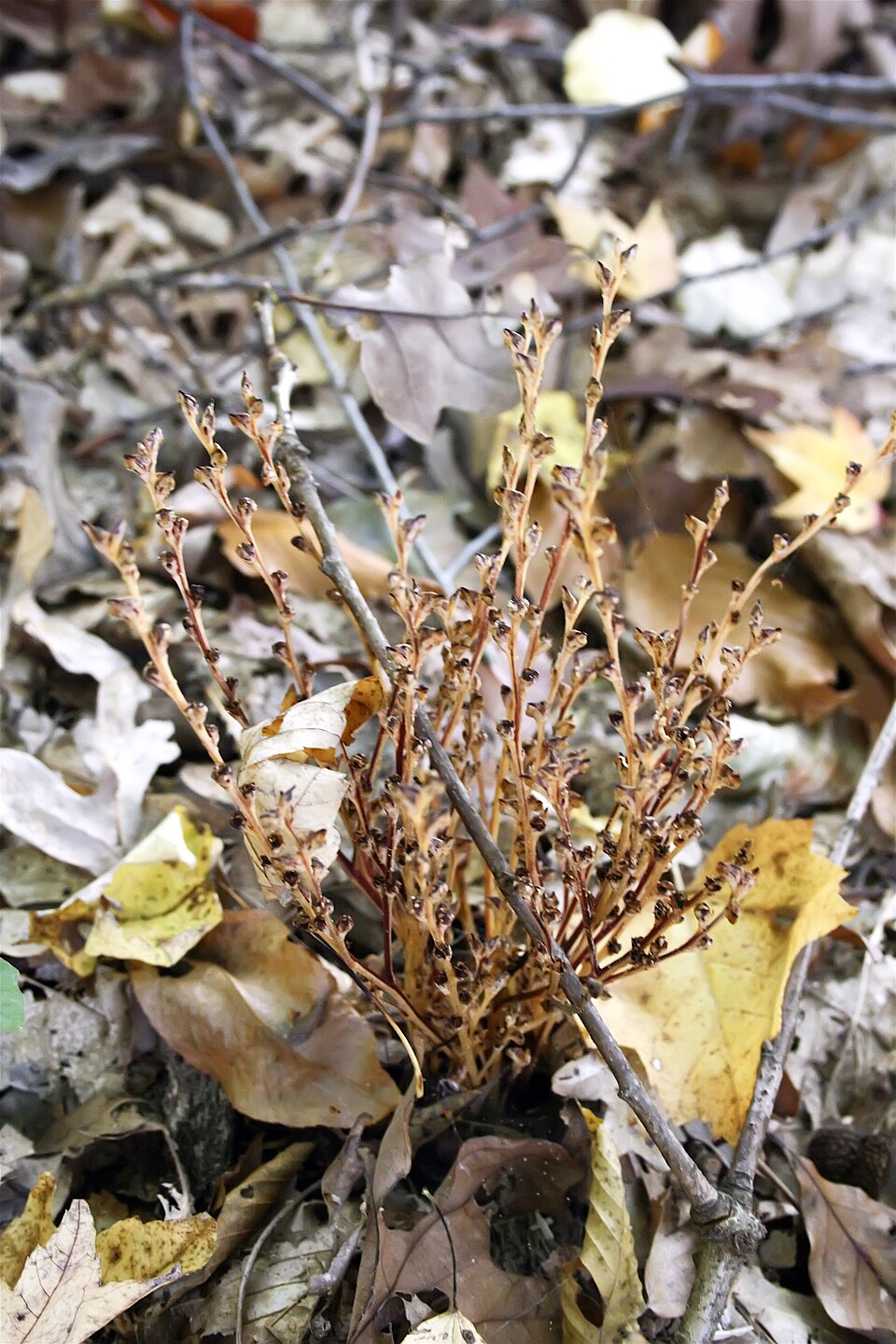
Epifagus virginiana is an annual parasitic plant in the broomrape family that lives entirely on the roots of American beech (Fagus grandifolia). It has no chlorophyll and produces no true leaves, instead growing as a cluster of slender, branched stems 5-20 inches (13-50 cm) tall in shades of tan, brown, and purple, dotted with small scale-like bracts. The stems rise from a knot of tissue attached to host roots by haustoria, through which the plant draws all its water and nutrients. From late summer into fall it bears two kinds of small tubular flowers: showy upper flowers about 0.4 inch (10 mm) long, whitish with purple-brown stripes, that rarely set seed, and self-pollinating lower flowers that stay closed and produce most of the seed. The whole plant is dry and brittle, turning brown and persisting as dead stalks through winter. Native to eastern North America wherever beech grows, it appears in colonies on the shaded forest floor near host trees. It cannot grow apart from a living beech and is never cultivated. The minute seeds germinate only when triggered by chemicals from beech roots.
Native Range
Native to eastern North America, from Nova Scotia and Ontario south to Florida and Louisiana, matching the range of American beech. It occurs in beech-dominated and mixed hardwood forests, always near its host.Suggested Uses
Epifagus virginiana is not a garden plant and appears only in beech woods as part of the native forest flora. It is of interest in woodland ecology and native plant study. Its presence points to established beech roots nearby.How to Identify
Appearance
Size & Dimensions
Height5" - 1'8"
Width/Spread4" - 1'
Bloom Information
Detailed Descriptions
Flower Description
whitish with purple-brown stripesGrowing Conditions
Sun Requirements
• Full Sun: 6+ hours of direct sunlight
• Partial Shade: 3-6 hours of direct sunlight
• Full Shade: Less than 3 hours of direct sunlight