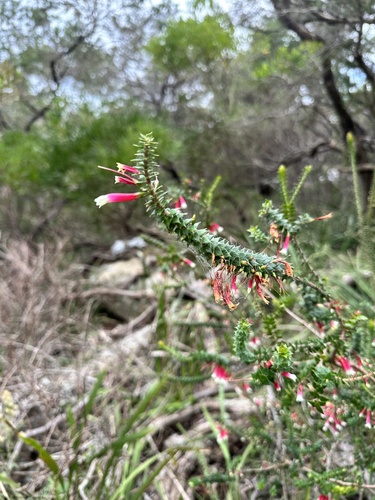
Epacris, Genus, longiflora, Species,
- Genus & species
fuchsia heath
Overview
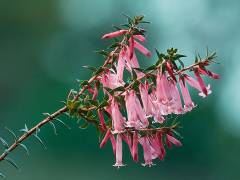
Epacris longiflora, fuchsia heath or native fuchsia, is a small, wiry evergreen shrub growing 0.3-1.5 m (1-5 ft) tall with a straggling, open habit and slender arching stems. The leaves are small, stiff, and heart-shaped at the base, 5-15 mm (0.2-0.6 in) long, with a sharp point, crowded along the wiry stems. Tubular pendant flowers about 2 cm (0.8 in) long hang in rows along the upper stems, red with white, flared tips. Flowering continues over much of the year, with a peak from autumn through winter into spring. The long-tubed flowers hold nectar at their base and are pollinated by honeyeaters. It grows on sandstone heath, woodland, and cliff faces in eastern Australia on acidic, sandy soils. The shrub is short-lived and open in habit, and grows poorly in heavy, wet, or limey soils.
Native Range
Native to eastern Australia, mainly in New South Wales and southern Queensland. It grows on sandstone heath, open woodland, and cliff faces on acidic, sandy soils.Suggested Uses
Grown in native, heath, and rockery gardens for its long flowering and bird appeal. Used in containers and on sandstone or low-nutrient soils where many plants struggle. Suited to bird-attracting and bushland-style plantings.How to Identify
Appearance
Size & Dimensions
Height1' - 4'11"
Width/Spread1' - 3'3"
Bloom Information
Detailed Descriptions
Flower Description
red with white tipsFoliage Description
greenGrowing Conditions
Sun Requirements
Requires 4-8 hours of direct sunlight daily
• Full Sun: 6+ hours of direct sunlight
• Partial Shade: 3-6 hours of direct sunlight
• Full Shade: Less than 3 hours of direct sunlight
Care & Maintenance
Care Guide
Grows in part sun to dappled shade on acidic, sandy, free-draining soils low in nutrients. Sharp drainage is needed, as the roots rot in heavy, wet, or limed soil. It needs steady but light moisture and does not tolerate drying out completely or heavy feeding. A light mulch of leaf litter and low-phosphorus conditions suit it, as with many Australian heath plants. Light frost is tolerated in its native range. The shrub is short-lived and may need replacing after a few years.Pruning
Light tip pruning after the main flush keeps the open, straggly stems bushier. Cutting back into bare older wood is risky and slow to reshoot. Removing spent flowering stems tidies the plant.Container Growing
Suitable for container growing
Minimum container size: 3 gallons