Drosera, Genus, spp., Multiple species,
- Genus
- Multiple species
sundews
Worldwide except Antarctica; centres in Australia, South Africa, and South America
Overview
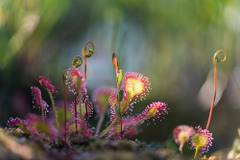
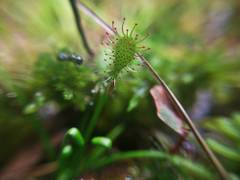
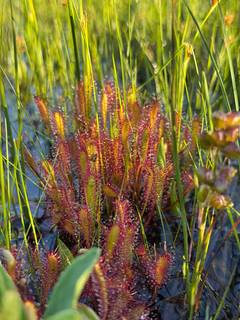
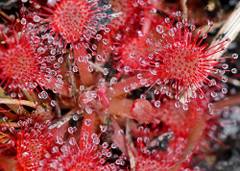
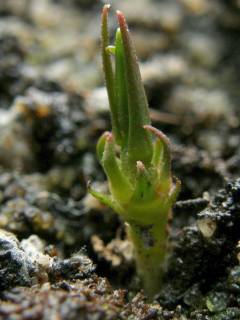
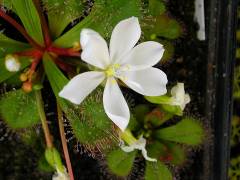
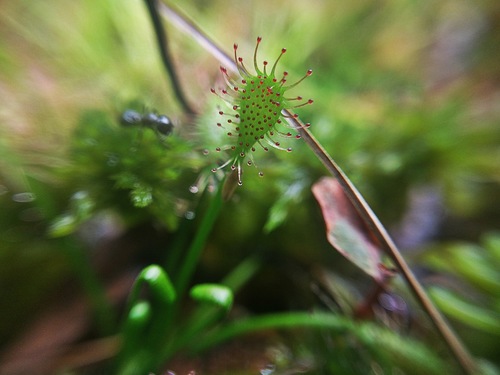
Drosera, the sundews, is a large genus of carnivorous plants, with about 250 species in the family Droseraceae, found on every continent except Antarctica and most diverse in Australia, South Africa, and South America. Plants form flat rosettes or erect, sometimes climbing or tuberous stems, ranging from pygmy species barely 1 cm (0.4 in) across to scrambling species over 1 m (3.3 ft) long. The leaves are covered with stalked glandular hairs tipped with glistening drops of sticky mucilage that trap small insects; the leaf or its tentacles then bend slowly around the prey and digest it, supplementing the nitrogen the plants cannot draw from their poor soils. Foliage ranges from green to deep red in strong light. Small five-petalled flowers in white, pink, or purple are held well above the traps on slender stalks, opening one at a time. Drosera grows in permanently wet, acidic, nutrient-poor bogs, seeps, and sandy ground. The plants are intolerant of mineral-rich water and fertiliser, and many temperate species die back to a resting bud or tuber in winter or during dry spells.
Native Range
Native worldwide except Antarctica, with the greatest concentration of species in southwestern Australia, South Africa's Cape region, and southern South America. Several species, including D. rotundifolia, are widespread across the cool peat bogs of the Northern Hemisphere.Suggested Uses
Grown in bog gardens, carnivorous-plant collections, and pots on sunny windowsills and in greenhouses and terraria. Hardy species such as D. rotundifolia are added to permanently wet, acidic outdoor bog beds alongside pitcher plants and Sarracenia.How to Identify
Appearance
Size & Dimensions
Height1" - 3'3"
Width/Spread1" - 1'
Bloom Information
Flowering time varies with climate and growth cycle. Temperate rosette species flower in summer, roughly June to August, while Australian winter-growing species bloom in the cooler months. Flowers open singly over several weeks, each lasting a day, and many species self-pollinate. Seed is minute and dust-like.
Detailed Descriptions
Flower Description
white, pink, or purpleFoliage Description
green to redGrowing Conditions
Sun Requirements
Requires 6-12 hours of direct sunlight daily
• Full Sun: 6+ hours of direct sunlight
• Partial Shade: 3-6 hours of direct sunlight
• Full Shade: Less than 3 hours of direct sunlight
Water & Climate
Water Needs
Care & Maintenance
Care Guide
Drosera grows in full sun to bright light in permanently moist, acidic, nutrient-poor medium such as a peat-and-sand or sphagnum mix. The plants are watered only with rain, distilled, or reverse-osmosis water, as minerals and tap-water salts are quickly fatal. Fertiliser is never added to the soil; the plants feed by catching small insects instead. Temperate species need a cool winter dormancy, dying back to a resting bud, while subtropical species grow year-round in warmth. Most are grown in pots standing in a tray of water during the growing season. Propagation is from seed, leaf cuttings, or division of clumps.Pruning
Pruning is limited to removing dead or blackened leaves and spent flower stalks to reduce mould in humid conditions. Old leaves are left until fully withered, as they continue to feed the plant. Resting buds and tubers of dormant species are left undisturbed.Container Growing
Suitable for container growing
Minimum container size: 1 gallons