Cynoglossum, Genus, officinale, Species,
- Genus & species
hound's-tongue
Overview
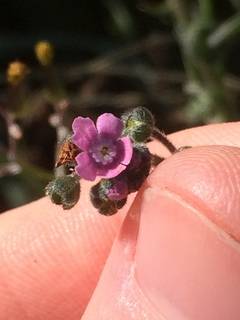
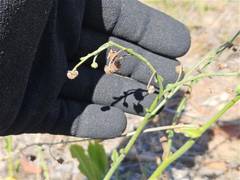
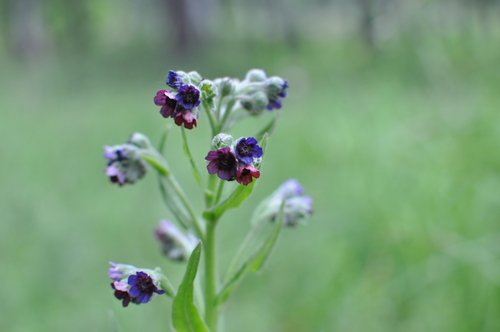
Cynoglossum officinale is a biennial in the borage family, forming a basal rosette in its first year and an erect, branched flowering stem 1-4 feet (30-120 cm) tall in its second. The whole plant is covered in soft grey-green hairs, giving the lance-shaped leaves a flannel-like feel; the largest basal leaves reach 12 inches (30 cm) long. From late spring into summer, coiled clusters at the stem tips uncoil to open funnel-shaped flowers 0.3-0.4 inch (8-10 mm) across, dull reddish-purple to maroon with five rounded lobes. Each flower yields four flattened, teardrop-shaped nutlets covered in barbed prickles that cling to fur and clothing, spreading the seed. Crushed foliage gives off a scent likened to mice. All parts contain pyrrolizidine alkaloids that damage the liver of grazing animals and cause chronic poisoning in cattle and horses. The plant grows on disturbed ground, pastures, roadsides, and rangeland, and it is listed as a noxious weed across much of western North America. It tolerates poor, dry soils but is short-lived, dying after it sets seed.
Native Range
Native to Europe and temperate Asia, where it grows in grassland, scrub, and disturbed ground. It has naturalised widely in North America and is listed as a noxious weed in many western states and Canadian provinces.Suggested Uses
Rarely planted by choice, it appears mainly as a weed of pasture and waste ground rather than a garden subject. Where it is grown for its historical use in herbal preparations, it is kept in contained beds away from livestock. Its flowers draw bees during the short bloom season.How to Identify
Appearance
Size & Dimensions
Height1' - 4'
Width/Spread1' - 2'
Bloom Information
Detailed Descriptions
Foliage Description
grey-greenGrowing Conditions
Sun Requirements
Requires 4-10 hours of direct sunlight daily
• Full Sun: 6+ hours of direct sunlight
• Partial Shade: 3-6 hours of direct sunlight
• Full Shade: Less than 3 hours of direct sunlight