Cynoglossum, Genus, spp., Multiple species,
- Genus
- Multiple species
Hound's-tongues
Temperate Europe, Asia, Africa, and the Americas
Overview
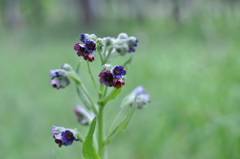
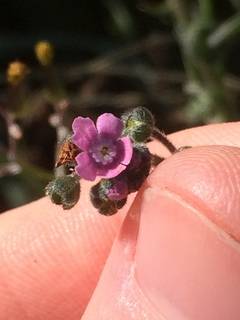
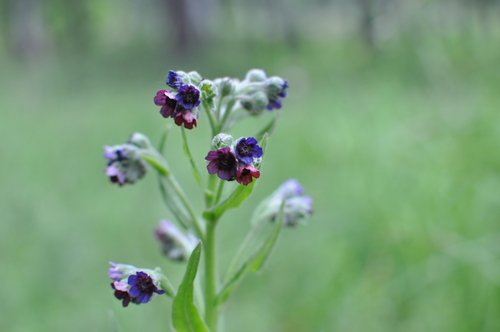
Cynoglossum is a genus of about 75 species of annual, biennial, and perennial herbs in the borage family, distributed across temperate and subtropical regions of Europe, Asia, Africa, and the Americas. Plants form a basal rosette and upright, branching flower stems 12-48 in (30-120 cm) tall and 12-24 in (30-60 cm) wide. The leaves are lance- to tongue-shaped, 2-12 in (5-30 cm) long, grey-green, and covered in soft to rough hairs that give the foliage a flannel-like feel. In late spring and summer the genus bears branched, curling sprays of small funnel-shaped flowers 0.2-0.5 in (5-12 mm) across, most often blue or violet but also pink, maroon, or white. Each flower yields four nutlets covered in barbed prickles that cling to fur and clothing for dispersal. Several species, including C. officinale, contain pyrrolizidine alkaloids that are toxic to grazing animals and people, and that species is listed as a noxious weed in parts of North America and Australia. C. amabile, the Chinese forget-me-not, is grown as an annual for its blue flowers. The genus tolerates poor, dry soils and self-seeds freely.
Native Range
The genus is native across temperate Europe, Asia, and Africa, with additional species in North and South America; C. officinale originates in Europe and Asia and has naturalized widely as a weed in North America.Suggested Uses
Grown in cottage gardens, wildflower borders, and naturalized plantings, with the annual Chinese forget-me-not spaced 9-12 in (23-30 cm) apart for blue spring colour. Drought-tolerant species suit dry banks and gravel gardens.How to Identify
Appearance
Size & Dimensions
Height1' - 4'
Width/Spread1' - 2'
Bloom Information
Flowering runs from late spring into summer, generally May to July, with biennial species blooming in their second year. The coiled flower sprays open progressively from the base outward over several weeks. Annual forms such as C. amabile flower within a single season from a spring sowing.
Detailed Descriptions
Flower Description
Blue, violet, pink, maroon, or whiteFoliage Description
Grey-green, soft-hairyGrowing Conditions
Sun Requirements
Requires 4-10 hours of direct sunlight daily
• Full Sun: 6+ hours of direct sunlight
• Partial Shade: 3-6 hours of direct sunlight
• Full Shade: Less than 3 hours of direct sunlight
Care & Maintenance
Care Guide
Grow in full sun to part shade in average, well-drained soil; the genus tolerates poor, dry, and rocky ground and dislikes wet winter soils. Water is needed only during extended drought once plants are established. Biennial and perennial species self-seed and can spread aggressively, so removing seed heads limits unwanted seedlings. All parts of C. officinale and several relatives contain pyrrolizidine alkaloids that are toxic to livestock, pets, and people if eaten. The barbed seeds cling to animals and clothing. Plants are hardy in USDA zones 3-8 depending on species.Pruning
Cut flower stems back after bloom to reduce self-seeding and tidy the rosette. Deadheading before the nutlets ripen stops the barbed seeds from spreading. Perennial species can be cut to the ground in late autumn.Pruning Schedule
Prune: July–August
summer
Container Growing
Suitable for container growing
Minimum container size: 2 gallons