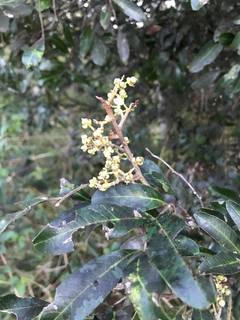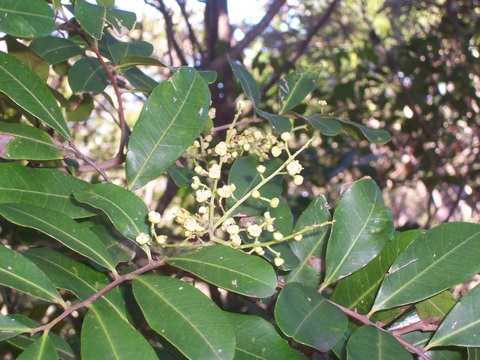
Cupaniopsis, Genus, anacardioides, Species,
- Genus & species
Tuckeroo
Overview
Cupaniopsis anacardioides is an evergreen tree growing 16-33 feet (5-10 m) tall and 16-26 feet (5-8 m) wide, with a dense, rounded canopy and a stout trunk. The pinnate leaves carry 4 to 12 leathery, blunt-tipped leaflets 2-5 inches (5-13 cm) long, glossy dark green above. Small cream to greenish flowers with a light scent are held in branched clusters from winter into spring. Woody three-lobed capsules about 0.8 inch (2 cm) wide follow, ripening yellow-orange and splitting to reveal black seeds wrapped in a red-orange aril that birds eat and disperse. Native to coastal eastern Australia, it withstands salt spray, sandy soils, and wind, which has made it a common street and park tree in warm climates. It tolerates drought once established but is frost-sensitive. Outside its native range it has naturalised and become an invasive weed in Florida, where it is known as carrotwood and is regulated as a prohibited species.
Native Range
Native to coastal eastern Australia, from Queensland south through New South Wales, where it grows on dunes, behind beaches, and along estuaries and littoral rainforest margins.Suggested Uses
Planted as a street, shade, and coastal screening tree in frost-free climates within its native range. Its arils support fruit-eating birds. In areas where it is invasive it is being replaced with local non-weedy species.How to Identify
Appearance
Size & Dimensions
Height16' - 33'
Width/Spread16' - 26'
Bloom Information
Cream to greenish flowers open from winter into spring, mainly July to September in the southern hemisphere. The branched clusters are followed over weeks by three-lobed capsules that ripen yellow-orange and open to display the red-arilled seeds.
Detailed Descriptions
Flower Description
cream to greenishFoliage Description
glossy dark greenGrowing Conditions
Sun Requirements
Requires 6-10 hours of direct sunlight daily
• Full Sun: 6+ hours of direct sunlight
• Partial Shade: 3-6 hours of direct sunlight
• Full Shade: Less than 3 hours of direct sunlight