Crepis, Genus, vesicaria, Species,
- Genus & species
beaked hawksbeard
Mediterranean region, southern and western Europe, and North Africa
Overview
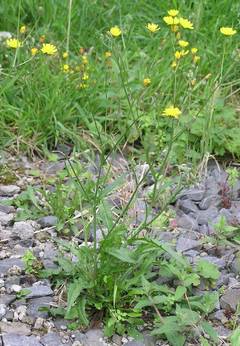
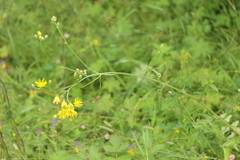
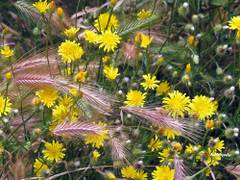
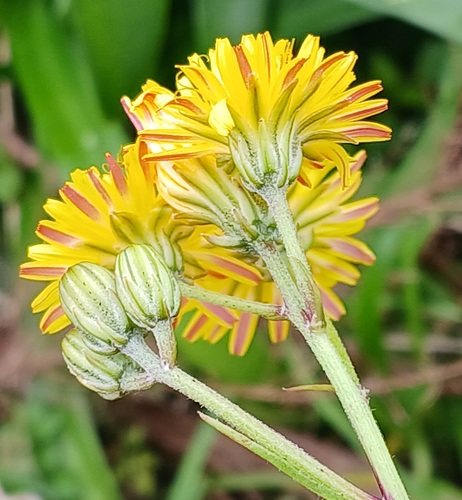
Crepis vesicaria is an annual or biennial 8-32 inches (20-80 cm) tall, forming a basal rosette of deeply lobed, dandelion-like leaves that taper to a winged stalk. From the rosette rise branched, leafy stems carrying many flower heads 0.6-1 inch (15-25 mm) across. Each head is a flat disc of yellow ray florets, often tinged orange or reddish on the underside of the outer rays. Flowering runs from May to July, after which the heads form ribbed seeds, each drawn out into a slender beak and topped with a white pappus of hairs that carries the seed on the wind. The leaves and hollow stems exude a milky latex when broken. A single plant branches widely and sets abundant seed before dying. It germinates in autumn or spring, overwinters as a rosette in the biennial form, and colonises open, disturbed ground rapidly. Growth is sparse in shade or closed turf.
Native Range
Native to the Mediterranean region, southern and western Europe, and North Africa, and widely naturalised across northern Europe, the British Isles, North America, and Australia. It grows on roadsides, walls, waste ground, lawns, field margins, and dry grassland on well-drained soils at low elevations.Suggested Uses
Grown in wildflower meadows, pollinator plantings, and naturalistic grassland on dry, open soils, where it self-seeds freely. Its rapid seeding suits informal or contained areas rather than borders and lawns, where it spreads as a weed. Flower heads draw bees, hoverflies, and other small pollinators.How to Identify
Appearance
Size & Dimensions
Height8" - 2'8"
Width/Spread8" - 1'4"
Bloom Information
Detailed Descriptions
Foliage Description
greenGrowing Conditions
Sun Requirements
Requires 5-9 hours of direct sunlight daily
• Full Sun: 6+ hours of direct sunlight
• Partial Shade: 3-6 hours of direct sunlight
• Full Shade: Less than 3 hours of direct sunlight
Care & Maintenance
Care Guide
Grows in full sun to light shade on free-draining soils and tolerates poor, dry, and disturbed ground. It is raised from seed sown in autumn or spring, scattered on open soil, and needs no feeding or watering once established. Self-sown seed spreads it widely across bare ground, so removing seed heads before the pappus forms limits its spread in cultivated areas. Few pests or diseases affect it. The biennial form overwinters as a rosette and flowers the following year, while the annual form completes its cycle in one season. Plants are pulled after seeding.Pruning
No structural pruning is needed. Flower heads are removed before the beaked seeds ripen to reduce wind-blown self-seeding. Spent plants are pulled or cut once seed has shed, since they do not regrow.Toxicity
Non-toxicPlanting Guide
Planting Methods & Timing
Planting Method
direct sow
Direct Sow Timing
autumn or spring