Corylopsis, Genus, spicata, Species,
- Genus & species
spike winter hazel
Japan (mountain forests on Shikoku and southern Honshu islands)
Overview
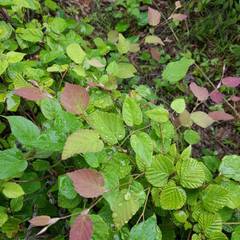
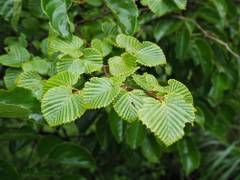
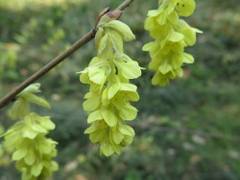
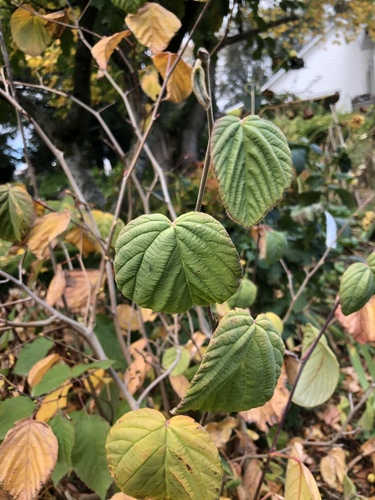
Corylopsis spicata is a medium spreading multi-stemmed deciduous shrub in the witch-hazel family (Hamamelidaceae) reaching 4–8 feet (1.2–2.4 m) tall with a spread of 6–10 feet (1.8–3 m) — wider than tall at maturity. The plant carries pendulous racemes 1.5–2.5 inches (4–6 cm) long of 6–12 small fragrant bright yellow flowers with conspicuous brick-red to dark red anthers in March–April before the leaves emerge. The brick-red anthers against bright yellow petals separate this species from every other Corylopsis in cultivation — no other commonly-grown winter hazel carries this yellow-and-red color contrast in the flowers. Leaves are broadly ovate 2–4 inches (5–10 cm) long, medium green with prominent veining, emerging with a bronzy tint after flowering. Fall color is yellow. The shrub develops a wide layered spreading form with zigzag branching that reads as architectural through winter after leaf drop. Growth rate is slow to moderate. Hardy to zone 5. This species is the most compact of the three Corylopsis species in this collection, carrying the smallest vertical footprint while still producing the characteristic pendulous yellow racemes. The March–April bloom is susceptible to late-frost damage that can eliminate the flower display for the year.
Native Range
Corylopsis spicata is native to Japan, where it occurs in mountain forests on Shikoku and southern Honshu islands.Suggested Uses
Grown as a specimen in woodland gardens, shaded borders, and foundation plantings at 5–7 foot (1.5–2.1 m) spacing. The compact mature size fits smaller residential gardens where C. glabrescens would overgrow the footprint within 10–15 years. The red-anthered yellow flowers carry a color contrast that reads differently from the plain yellow racemes of the other winter hazels. Woodland-edge positions and mixed shrub borders align with the natural habit. Pairing with early bulbs (Narcissus, Crocus) and Helleborus species builds a coordinated March–April display. West- or north-facing sheltered positions hold the flower display through the late-frost risk period more reliably than east-facing open exposures. Container culture works in 10 gallon (38 L) or larger pots with consistent irrigation.How to Identify
Appearance
Size & Dimensions
Height4' - 8'
Width/Spread6' - 10'
Bloom Information
Pendulous racemes 1.5–2.5 inches (4–6 cm) long of 6–12 small fragrant bright yellow flowers with conspicuous brick-red anthers open in March–April before the leaves emerge. Bloom duration is 2–3 weeks. Fragrance is light and sweet at close range. Late frosts during the bloom window damage the flowers and eliminate the display for the remaining period.
Detailed Descriptions
Flower Description
Bright yellow with brick-red to dark red anthers; pendulous racemes 1.5-2.5 inches long of 6-12 flowersFoliage Description
Medium green with prominent veining; broadly ovate 2-4 inches long; emerging bronzy tintGrowing Conditions
Sun Requirements
Requires 3-8 hours of direct sunlight daily
• Full Sun: 6+ hours of direct sunlight
• Partial Shade: 3-6 hours of direct sunlight
• Full Shade: Less than 3 hours of direct sunlight
Care & Maintenance
Care Guide
Grows in partial shade to full sun in moist well-drained acidic soil at pH 5.0–6.5 enriched with organic matter, tolerating loam. Hardy to zone 5. Partial shade protects the early flowers from late-frost damage. Positions exposed to direct early-morning sun after an overnight frost allow rapid thawing that ruptures frost-damaged flower tissue, so west- or north-facing sheltered positions hold bloom displays through the frost-risk period more reliably than east-facing open positions. Consistent moisture supports establishment. The compact mature size at 4–8 feet makes this the most manageable Corylopsis for residential-scale gardens. No serious pest or disease problems.Pruning
Minimal pruning is required. Dead or crossing branches are removed after flowering in late spring (May). The natural layered spreading form develops without structural intervention. Flowering occurs on old wood; pruning in fall or winter removes developing flower buds and eliminates the following spring's display.Pruning Schedule
Prune: May
late spring
Container Growing
Suitable for container growing
Minimum container size: 10 gallons