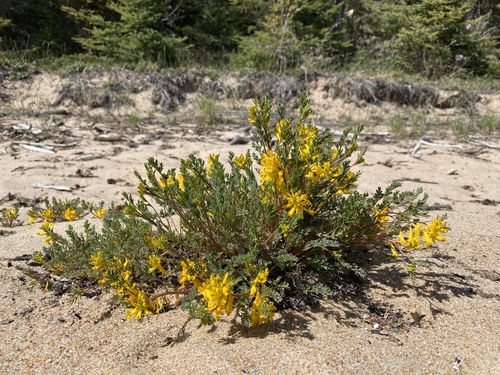
Corydalis, Genus, aurea, Species,
- Genus & species
golden corydalis
SunFull Sun – Part Shade
Overview
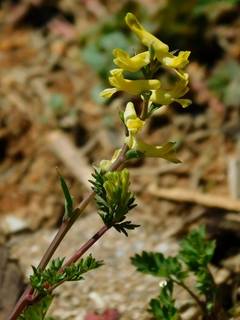
Corydalis aurea is a low annual to biennial in the Papaveraceae, forming sprawling mounds 6-16 in (15-40 cm) tall and about as wide. The blue-green foliage is finely dissected into small, fern-like segments on weak, branching stems that often lean or trail along the ground. From spring into early summer it carries short racemes of golden-yellow tubular flowers about 0.5-0.75 in (12-18 mm) long, each two-lipped with a short backward-pointing spur. Slender curved seed capsules follow and split to release shiny black seeds, each bearing an oil-rich appendage that ants collect and disperse. Corydalis aurea grows from a slender taproot in disturbed, gravelly, or sandy ground and behaves as a short-lived pioneer, germinating after soil disturbance and dying once seed is set. It is widespread across much of North America, from Alaska and Canada south through the western and central United States. All parts contain isoquinoline alkaloids, and the foliage can poison livestock that graze it in quantity. The plant is short-lived and weedy in habit, persisting through reseeding rather than as established clumps, and it fades quickly once hot, dry weather arrives. It occupies open, sunny to lightly shaded sites with sharp drainage.
Native Range
Widespread across much of North America, from Alaska and across Canada south through the Rocky Mountains and central United States into northern Mexico. It grows in disturbed soils, gravelly slopes, streambanks, and open woodland clearings.Suggested Uses
Used in naturalized areas, rock gardens, and disturbed or gravelly sites where short-lived self-seeding fillers are wanted. Suited to wild and pollinator plantings. Its weedy, trailing habit suits informal settings rather than tidy borders.How to Identify
Appearance
Size & Dimensions
Height6" - 1'4"
Width/Spread8" - 1'
Colors
Flower Colors
Foliage Colors
Bloom Information
Detailed Descriptions
Foliage Description
blue-greenGrowing Conditions
Sun Requirements
Requires 4-8 hours of direct sunlight daily
• Full Sun: 6+ hours of direct sunlight
• Partial Shade: 3-6 hours of direct sunlight
• Full Shade: Less than 3 hours of direct sunlight
Water & Climate
Water Needs
Drought Tolerance
Drought tolerant when established
Care & Maintenance
Care Guide
Grows in full sun to part shade in sharply drained sandy, gravelly, or rocky soil. It tolerates poor, disturbed ground and drought once rooted, and remains short-lived in any conditions. Soil pH from 6.0 to 7.5 suits it, and no fertilizer is needed. Seed needs a cold, moist period to germinate, so fresh seed sown in fall sprouts the following spring. All parts contain alkaloids that are toxic if eaten, which also makes the foliage unpalatable to deer and rabbits.Pruning
No pruning is required. Plants can be pulled or sheared once flowering ends and seed has set, or left to self-sow. Removing spent plants before capsules ripen reduces volunteer seedlings the next season.Pruning Schedule
summer
Toxicity Warning
Toxic to pets and humansPlanting Guide
Planting Methods & Timing
Planting Method
direct sow
Direct Sow Timing
Sow fresh seed in fall; seed requires cold, moist stratification
Plant Spacing
8 inches