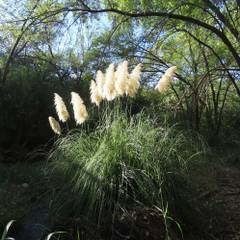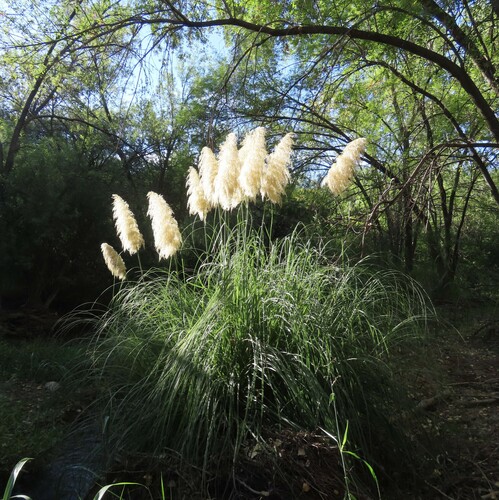
Cortaderia, Genus, spp., Multiple species,
- Genus
- Multiple species
pampas grasses
South America (Argentina, Chile, Brazil, and the Andes), with a few species in New Zealand and New Guinea
Overview
Cortaderia is a genus of about 20 large, tussock-forming perennial grasses in the family Poaceae, the pampas grasses. Plants form dense clumps of arching, blue-green to green leaves 3-6 ft (0.9-1.8 m) long with finely toothed, sharp-edged margins. In late summer the clumps send up stout flowering stems that lift feathery plumes well above the foliage, the whole plant reaching 6-13 ft (1.8-4 m) tall and 4-6 ft (1.2-1.8 m) wide. Plumes are 1-3 ft (30-90 cm) long in shades of silvery white, cream, and pink, and most species are dioecious, with female plants carrying fuller, silkier plumes than the males. Seed is produced in large quantities and disperses on the wind, and C. selloana and C. jubata have naturalized aggressively and are listed as invasive in California, coastal Oregon, Hawaii, Australia, New Zealand, South Africa, and parts of the Mediterranean. The genus is native to South America and New Zealand. Leaf margins are sharp enough to cut skin, and old foliage builds up as a flammable thatch at the clump base.
Native Range
Cortaderia is native to South America, where most species grow in the grasslands, riverbanks, and mountain slopes of Argentina, Chile, Brazil, and the Andes, with a few species native to New Zealand and New Guinea. Several species have naturalized far outside this range and are regulated as invasive in California, the Pacific Northwest, Hawaii, Australia, New Zealand, and South Africa.Suggested Uses
Planted as a screening clump, windbreak, or coastal accent in large open spaces where its size and spread match the scale. Cut plumes are dried for indoor arrangements. Spaced 6-8 ft (1.8-2.4 m) apart; planting is restricted or discouraged in regions where the genus is invasive.How to Identify
Appearance
Size & Dimensions
Height6' - 13'
Width/Spread4' - 6'
Bloom Information
Cortaderia flowers in late summer and autumn, typically August to October in the Northern Hemisphere. The plumes hold their form into winter, fading from silvery white or pink to tan as they dry. A single mature female clump can carry dozens of flowering stems and shed thousands of wind-borne seeds.
Detailed Descriptions
Flower Description
Silvery white, cream, to pinkFoliage Description
Blue-green to greenGrowing Conditions
Sun Requirements
Requires 6-10 hours of direct sunlight daily
• Full Sun: 6+ hours of direct sunlight
• Partial Shade: 3-6 hours of direct sunlight
• Full Shade: Less than 3 hours of direct sunlight