Cortaderia, Genus, selloana, Species,
- Genus & species
pampas grass
South America — the pampas grasslands of Argentina, Uruguay, Brazil, and Chile; native to temperate South American grassland habitats with hot summers, mild winters, and well-drained soils.
Overview
Cortaderia selloana is pampas grass (also called South American pampas grass), a clumping warm-season ornamental grass in the grass family (Poaceae) growing 72-120 inches (180-300 cm) tall and 60-96 inches (150-240 cm) wide. The common name 'pampas grass' references the pampas grasslands of central Argentina and Uruguay where the species is native, and the genus name Cortaderia comes from the Spanish 'cortar' meaning 'to cut' — referencing the razor-sharp leaf margins that distinguish the species across the genus. The species produces enormous silvery-white to creamy-white feathery plumes 12-36 inches (30-90 cm) long on tall stems above the foliage clump from September through November across an 8-week active flowering window — the large-scale plume display gives the species its status as one of the more recognizable ornamental grasses in worldwide cultivation, and the female-plant plumes are the larger and showier display compared to the smaller tan plumes that male plants produce. The species is dioecious — separate male and female plants are produced rather than hermaphroditic individuals carrying both sexes — and most ornamental nursery stock is selected for the larger female-plant plume display. Two physical characters of the species require explicit attention in cultivation: first, the leaf margins carry razor-sharp microscopic silica teeth (serrate edges with silicate phytoliths embedded in the leaf cuticle) that can cause deep skin lacerations on direct contact, and the leaf-margin sharpness affects siting decisions (where contact with people is likely) and pruning protocols (gloves and protective sleeves are standard practice). Second, the species has escaped cultivation and naturalized as an invasive species in coastal California, Hawaii, parts of the southeastern United States, the Mediterranean basin, Australia, and New Zealand, where the species' wind-dispersed seeds and fast establishment in disturbed open habitats outcompete native vegetation; the species is regulated as a noxious or invasive weed in California, Hawaii, parts of Florida, and other jurisdictions, and the regulation status varies by state and country and is the cultivation-relevant fact for siting decisions in those regions. The species is native to South American pampas grassland habitats of Argentina, Uruguay, Brazil, and Chile, where the warm-summer dry-winter climate and the well-drained substrate of the pampas-grassland native habitat create the cultivation conditions the species evolved with; the species' subtropical-to-warm-temperate native climate range gives reliable cold-hardiness through zone 7 with mulching protection at zone 7 and reliable performance across zones 7-11. The species is the principal ornamental member of the genus Cortaderia (which carries about 25 species native to South America and New Zealand), and the species' large-scale plume display, evergreen foliage clump, and broad climatic tolerance together account for the worldwide ornamental cultivation history dating from the 19th century. Drought-tolerant once established. Deer avoid the foliage from the razor-sharp leaf-margin physical deterrent. The species is non-toxic to humans and pets if ingested but carries the cutaneous-laceration concern from physical leaf-margin contact.
Native Range
Cortaderia selloana is native to South America with a continuous native range across the pampas grasslands of central Argentina (the type locality is the Argentine pampas), Uruguay, southern Brazil, and Chile. The species occurs in temperate South American grassland habitats with hot summers, mild winters, well-drained substrate, and full-sun exposure across the pampas-grassland native range, where the species' physiological adaptation to the South American grassland climate creates the broad cultivation tolerance the species carries in commercial horticulture worldwide. The species has been introduced and naturalized as an invasive species in coastal California, Hawaii, the Iberian Peninsula, the Mediterranean basin, parts of the southeastern United States, Australia, and New Zealand following 19th-century ornamental introduction; the species is regulated as a noxious or invasive weed in California, Hawaii, parts of Florida, and other jurisdictions, and the regulation status varies by state and country.Suggested Uses
Used as a large-scale specimen accent, privacy screen, foundation planting, architectural accent at landscape scale, and as the principal large-scale ornamental grass in residential and commercial landscapes where the 6-10 foot scale fits the planting space. The species' enormous silvery plume display gives a fall-and-winter ornamental contribution at a scale that few other ornamental plants match, and the year-round evergreen foliage clump supplies the structural component that makes the species usable as a privacy screen or foundation accent. The species is regulated as invasive in California, Hawaii, parts of Florida, and other jurisdictions where the regulation status precludes ornamental use; in those regions, alternative non-invasive ornamental grasses including Saccharum ravennae (ravenna grass), Miscanthus 'Purpurascens' (flame grass), and large Panicum virgatum switchgrass cultivars produce large-scale ornamental displays without the invasiveness concern. The razor-sharp leaf margins affect siting in landscapes where contact with people is likely, and the species is sited away from paths, play areas, and high-traffic positions. The species pairs with companion large-scale ornamental grasses, evergreen shrubs, and architectural specimens for multi-element landscape compositions where the Cortaderia plume display anchors the planting at the principal large-scale element.How to Identify
Appearance
Size & Dimensions
Height6' - 10'
Width/Spread5' - 8'
Colors
Bloom Information
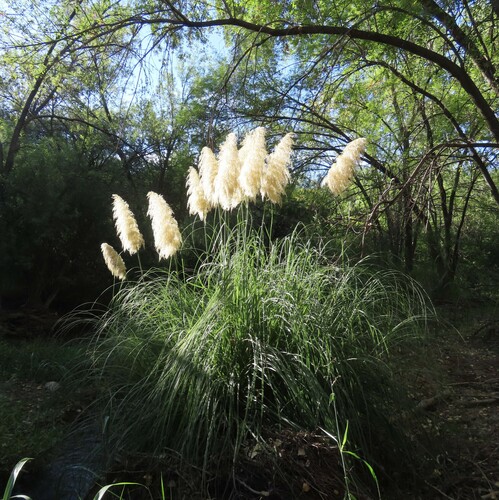
Enormous silvery-white to creamy-white feathery plumes 12-36 inches (30-90 cm) long open on tall stems above the foliage clump from September through November across an 8-week active flowering window (female plants); male plants produce smaller and less showy tan plumes across the same flowering window. The plumes persist on standing stems past the active flowering window and continue display through fall and winter as silvery-aged plumes that hold structural and color value across the dormant season. Pollination is by wind in the typical grass-family pattern, with the dioecious breeding system requiring both male and female plants in proximity for viable seed production; in cultivated landscapes where only female plants are present, no seed is produced and the species behaves as a non-self-sowing ornamental.
Detailed Descriptions
Flower Description
Silvery-white to creamy-white in enormous feathery plumes 12-36 inches (30-90 cm) long carried on tall stems above the foliage clump (female plants); male plants produce smaller and less showy tan plumes; the species is dioecious — separate male and female plants are produced rather than hermaphroditic individuals — and most ornamental nursery stock is selected for the larger and showier female-plant plume displayFoliage Description
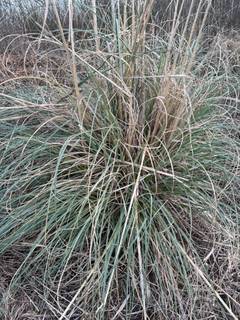
Gray-green; very long narrow arching leaf blades up to 6 feet (180 cm) long arranged in a dense fountain-shaped clump that produces the species' large-scale architectural form; the leaf margins carry razor-sharp microscopic silica teeth (serrate edges with silicate phytoliths embedded in the leaf cuticle) that can cause deep skin lacerations on contact, and the leaf-margin sharpness is a fact-of-cultivation that affects siting and maintenance practice for the speciesGrowing Conditions
Sun Requirements
Requires 6-12 hours of direct sunlight daily
• Full Sun: 6+ hours of direct sunlight
• Partial Shade: 3-6 hours of direct sunlight
• Full Shade: Less than 3 hours of direct sunlight
Care & Maintenance
Care Guide
Plant in full sun with at least 6 hours of direct light. Most well-drained soil types support the species at pH 6.0-8.0 — the species tolerates clay, loam, sand, and alkaline conditions and does not require specialized substrate. Watering is during establishment only because the species is drought-tolerant once the basal-clump root system develops. Fertilization is generally not needed because the species is adapted to lean grassland substrate. The cultivar is hardy to zone 7 with mulching protection at the zone-7 cold edge and performs reliably across zones 7-11. The principal annual maintenance task is cutting the entire foliage clump back to 12 inches (30 cm) above ground level in late February through March before new spring growth emerges; the cutback is physically demanding because the foliage volume is large and the leaf margins carry razor-sharp cutting edges that cause skin lacerations on contact, and standard practice is heavy gloves, long sleeves, and protective eyewear during cutback, with some gardeners tying the foliage clump with rope before cutting to control the sharp debris. The cutback may be deferred indefinitely in mild zones (9-11) where the foliage holds evergreen across multiple seasons, but most cultivated specimens benefit from periodic full cutback to refresh the foliage clump. Siting decisions: the razor-sharp leaf margins are a fact of the species and affect siting in landscapes where people, children, or pets contact the foliage; the species is sited away from paths, play areas, and high-traffic positions in most cultivated landscapes. Regulatory status: the species is regulated as a noxious or invasive weed in California, Hawaii, parts of Florida, and other jurisdictions; in those regions, alternative non-invasive ornamental grasses including Saccharum ravennae (ravenna grass), Miscanthus 'Purpurascens' (flame grass), and large Panicum virgatum cultivars produce comparable large-scale ornamental display without the invasiveness concern.Pruning
Cut the entire foliage clump back to 12 inches (30 cm) above ground level in late February through early March before new spring growth emerges. The cutback is physically demanding because of the large foliage volume and the razor-sharp leaf margins; standard horticultural practice is heavy leather gloves, long-sleeved heavy clothing, and protective eyewear for the cutback work. Some gardeners tie the foliage clump with rope before cutting to control the sharp debris and reduce hand contact with the cut leaves. The cutback may be deferred in mild zones (9-11) where the foliage holds evergreen across multiple seasons, but periodic full cutback refreshes the foliage clump and maintains the architectural form. Leave the silvery plumes standing through fall and winter for continuing structural and color value across the dormant season.Pruning Schedule
Prune: February–March
early spring