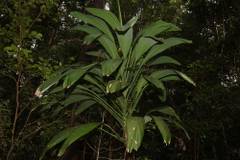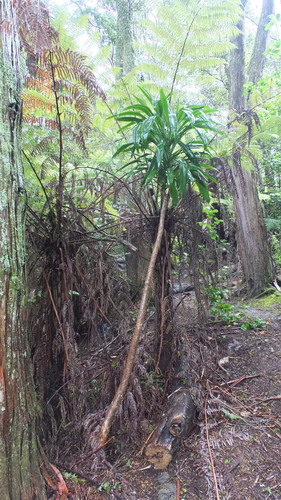
Cordyline, Genus, spp., Multiple species,
- Genus
- Multiple species
cabbage trees and allies
Western Pacific - New Zealand, eastern Australia, New Guinea, Southeast Asia, and Polynesia, with a few species in South America
Overview
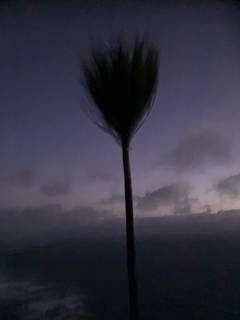
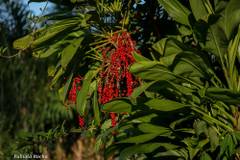
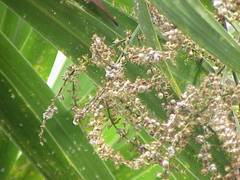
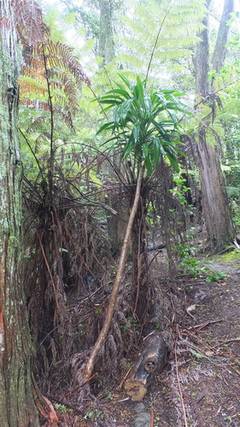
Cordyline is a genus of roughly 15 evergreen woody monocots in the family Asparagaceae, ranging from multi-stemmed shrubs to single-trunked trees 3-66 ft (1-20 m) tall. Stems stay unbranched until flowering, then fork, producing the candelabra outline seen in mature C. australis. Leaves cluster at stem tips in dense terminal rosettes, strap-shaped to lance-shaped, 1-3 ft (30-90 cm) long and 0.4-4 in (1-10 cm) wide, with parallel venation; color runs from green in wild species to bronze, purple, pink, and cream-variegated in cultivated selections of C. fruticosa and C. australis. Flowering stems carry branched panicles 1-3.3 ft (30-100 cm) long with many small six-tepaled flowers in white to pale lilac, followed by white, blue, or purple berries 0.2-0.3 in (5-8 mm) across. Cold tolerance varies across the genus: C. australis withstands brief frost to about 14F (-10C), while C. fruticosa is damaged below 40F (4C). Most species need steady moisture while establishing and decline in prolonged drought. Leaf spot, stem rot, and root rot occur in poorly drained sites, and scale and mealybugs affect plants grown indoors.
Native Range
Cordyline species are native to the western Pacific and adjacent regions, with centers of diversity in New Zealand, eastern Australia, New Guinea, and the islands of Southeast Asia and Polynesia. One species, C. fruticosa, has been carried widely across the tropics through human cultivation. A few species occur in southeastern South America.Suggested Uses
Grown as a structural specimen, in mixed borders, and in coastal and subtropical plantings where C. australis tolerates wind and salt. Colored-leaf forms of C. fruticosa are kept as container and indoor foliage plants. Spaced 3-6 ft (0.9-1.8 m) apart in landscape groupings.How to Identify
Appearance
Size & Dimensions
Height3' - 66'
Width/Spread3' - 13'
Bloom Information
Most Cordyline species flower from late spring into summer, roughly May to July in the Northern Hemisphere and November to January in the Southern Hemisphere. Panicles rise from the leaf rosette and carry hundreds of small fragrant flowers over about 3-6 weeks. Many species begin flowering only on stems several years old, so young plants often stay non-flowering.
Detailed Descriptions
Flower Description
White to pale lilacFoliage Description
Green to bronze, purple, pink, or cream-variegatedGrowing Conditions
Sun Requirements
Requires 4-8 hours of direct sunlight daily
• Full Sun: 6+ hours of direct sunlight
• Partial Shade: 3-6 hours of direct sunlight
• Full Shade: Less than 3 hours of direct sunlight
Water & Climate
Water Needs
Care & Maintenance
Care Guide
Across the genus, Cordyline grows in full sun to part shade, with colored-leaf and variegated forms holding color in brighter light. Plants need free-draining soil and steady moisture through the first few seasons; established C. australis tolerates short dry spells, while C. fruticosa keeps higher water needs. Soil pH from about 5.5 to 7.5 suits most species. Hardiness ranges from USDA zones 8-11 for C. australis down to tender tropical species kept as container or indoor plants and moved under cover near 40F (4C). Leaf spot, stem rot, and root rot follow waterlogged soil, and scale insects and mealybugs occur on indoor plants.Pruning
Routine pruning is minimal. Spent flower panicles and browned lower leaves are removed by hand or with shears as they age. Stems cut back to 4-12 in (10-30 cm) in spring resprout from the base or trunk, a method used to renew leggy plants of C. australis and C. fruticosa.Container Growing
Suitable for container growing
Minimum container size: 5 gallons