Overview
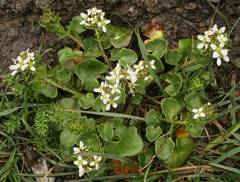
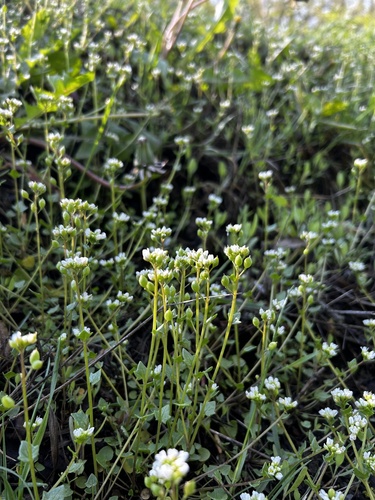
Cochlearia danica is a small annual or winter-annual in the cabbage family Brassicaceae, forming a low, branching, often sprawling plant 2-8 inches (5-20 cm) tall and 4-8 inches (10-20 cm) across. The lowest leaves are long-stalked, ivy-shaped, and slightly fleshy, 0.2-0.8 inch (5-20 mm) long, while the stem leaves are smaller and often stalkless. From January to June it produces masses of small four-petalled flowers 0.1-0.2 inch (3-5 mm) across, white to pale lilac or mauve, followed by short egg-shaped seed pods. It germinates in autumn, overwinters as a small rosette, and flowers and dies within a year. The species is native to the coasts of western and northern Europe, on shingle, dunes, cliffs, walls, and other dry, open ground, often where salt accumulates. Since the late twentieth century it has spread far inland along the salted central reservations and verges of major roads, forming white ribbons of flower in early spring. Its short life and need for open, salty or disturbed ground mean it does not persist in closed, fertile turf.
Native Range
Native to the coasts of western and northern Europe, from Scandinavia and the Baltic south to Spain and Portugal. It grows on shingle beaches, sand dunes, sea cliffs, walls, and bare saline ground, and has spread inland along the salt-treated verges of motorways and trunk roads.Suggested Uses
Grown rarely, mainly in coastal, gravel, and wildlife gardens, or wherever an early-flowering salt-tolerant annual suits dry, open ground. It self-sows on gravel drives, paths, and wall tops to give early spring flower. It is more often noticed as a wild colonist of road verges than as a planted subject.How to Identify
Appearance
Size & Dimensions
Height2" - 8"
Width/Spread4" - 8"
Bloom Information
Flowering is early and long, running from January to June and peaking in March and April, when roadside colonies turn white. The small flowers are visited by early bees and flies, and self-pollination is also common. Seed pods ripen quickly, and the plant completes its life cycle by early summer.
Detailed Descriptions
Flower Description
white to mauveFoliage Description
greenGrowing Conditions
Sun Requirements
Requires 6-12 hours of direct sunlight daily
• Full Sun: 6+ hours of direct sunlight
• Partial Shade: 3-6 hours of direct sunlight
• Full Shade: Less than 3 hours of direct sunlight
Water & Climate
Water Needs
Drought Tolerance
Drought tolerant when established
Care & Maintenance
Care Guide
Cochlearia danica grows in full sun on dry, free-draining, open soils, including sand, shingle, gravel, and disturbed ground, and tolerates high salt levels that suppress competing plants. It is an annual raised only from seed, which germinates in autumn to overwinter as a rosette before flowering the following spring. In gardens it is seldom cultivated deliberately and needs no feeding or watering, persisting only where the ground stays open and is not shaded out by larger plants. Salt is not required but reduces competition and favours its spread. Plants set abundant seed and may self-sow on gravel, paths, and walls. Once flowering finishes the whole plant dies and is easily pulled up.Toxicity
Non-toxicPlanting Guide
Planting Methods & Timing
Planting Method
direct sow
Direct Sow Timing
Autumn, for flowering the following spring
Plant Spacing
6 inches