Overview
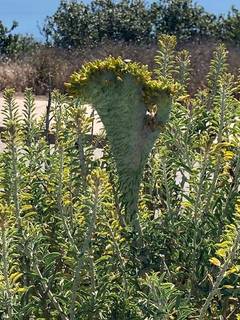
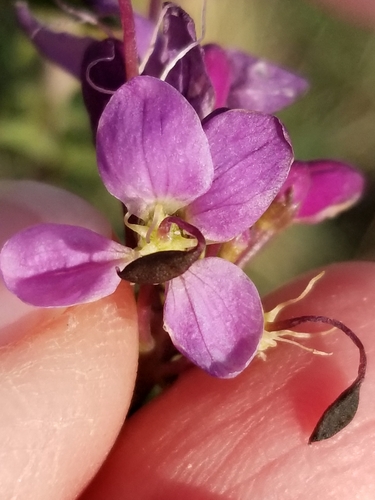
Cleomella serrulata, long known as Cleome serrulata, is an erect annual in the spiderflower family, growing 1-5 feet (30-150 cm) tall on a single branching stem. Its leaves are palmately compound with three narrow leaflets, each 1-2.5 inches (2.5-6 cm) long, alternating up the stem. From early summer into autumn it carries rounded to elongated clusters of pink to rose-purple flowers at the stem tips; each small flower has four petals and long protruding stamens that give the cluster a fluffy outline. As lower flowers fade, narrow seed pods 1-2 inches (2.5-5 cm) long hang below the still-opening upper flowers on slender stalks. The plant grows quickly from seed in a single season in disturbed ground, prairies, rangeland, and roadsides, often forming large stands after wet springs. It is a major nectar and pollen source for bees, which gives it the common name. The foliage has a strong scent that some find unpleasant. As an annual it dies after setting seed, relying on the seed bank to return the next year.
Native Range
Cleomella serrulata is native to western and central North America, from the Canadian prairie provinces south through the Great Plains and Rocky Mountain region into the Southwest. It grows in prairies, rangeland, disturbed ground, and roadsides on a range of soils.Suggested Uses
Cleomella serrulata is used in pollinator and native plant gardens, wildflower meadows, and restoration of disturbed prairie and rangeland. Its long bloom and heavy nectar flow suit bee and butterfly plantings. It combines with sunflowers, native grasses, and other prairie annuals in naturalized beds.How to Identify
Appearance
Size & Dimensions
Height1' - 5'
Width/Spread1' - 2'
Bloom Information
Flowering runs from early summer into autumn, roughly June to September. Each cluster blooms from the bottom upward over several weeks, so flowers and developing pods appear on the same stalk at once. Bees of many kinds work the flowers heavily through the day. Seed pods ripen and split in late summer and fall to drop numerous seeds.
Detailed Descriptions
Flower Description
pink to rose-purpleFoliage Description
greenGrowing Conditions
Sun Requirements
Requires 6-10 hours of direct sunlight daily
• Full Sun: 6+ hours of direct sunlight
• Partial Shade: 3-6 hours of direct sunlight
• Full Shade: Less than 3 hours of direct sunlight
Water & Climate
Water Needs
Drought Tolerance
Drought tolerant when established
Care & Maintenance
Care Guide
Cleomella serrulata grows in full sun and well-drained soil, tolerating poor, dry, sandy, or disturbed ground. As a fast annual it is grown from seed sown in autumn or early spring, and it self-sows readily once established. Seed germinates more evenly after a period of cold, moist conditions. The plant needs little water once up and declines in rich, wet soil. It needs no fertilizer in average to lean soils. After it sets seed and dies in autumn, the dry stalks can be cleared and some seed left to maintain the stand.Pruning
No structural pruning is needed for this annual. Spent stalks can be cut or pulled once seed has dropped in autumn. Removing seed pods before they ripen limits self-sowing where a smaller stand is wanted.Toxicity
Non-toxicPlanting Guide
Planting Methods & Timing
Planting Method
direct sow
Direct Sow Timing
Autumn or early spring
Days to Maturity
60–100 days
Plant Spacing
18 inches
Companion Planting
Good Companions