Cinnamomum, Genus, camphora, Species,
- Genus & species
Camphor tree
Southern China, Taiwan, southern Japan, Korea, northern Vietnam
Overview
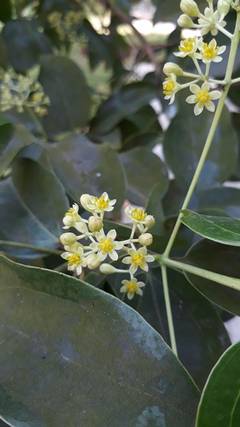
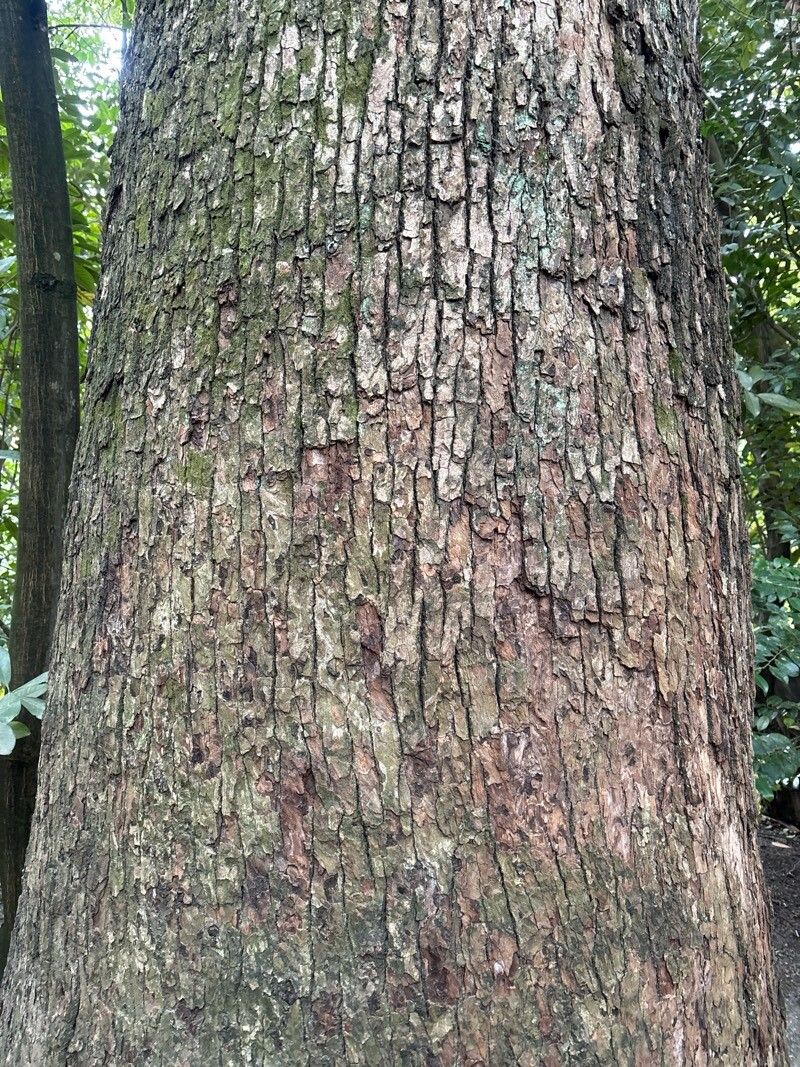
Cinnamomum camphora is an evergreen tree reaching 50-70 feet (15-21 m) tall and 50-80 feet (15-24 m) wide in cultivation, with a broad domed crown on a short trunk that thickens to 6-10 feet (1.8-3 m) in diameter on old specimens. Bark is grey-brown and vertically fissured. Leaves are alternate, ovate to elliptic, 2-5 inches (5-12 cm) long, glossy above and pale beneath, with three main veins running from near the leaf base and small pocket-shaped domatia in the vein axils; crushed foliage releases camphor. New growth flushes pink-bronze in spring, as the previous year's leaves colour red and drop over 2-3 weeks. Flowers are 0.1 inch (2-3 mm) across, cream to greenish-yellow, held in branched panicles 2-3 inches (5-8 cm) long in April and May. Fruit is a black drupe 0.3 inch (7-8 mm) across ripening September to November and spread by birds, and seedlings come up in numbers under and well beyond the canopy. Surface roots lift paving and kerbs within 15-20 feet (4.5-6 m) of the trunk. Camphor from the wood and foliage causes seizures on ingestion at doses above about 30 mg per kilogram of body weight. The species is recorded as an environmental weed through coastal New South Wales and southeast Queensland and is listed as a Category I invasive plant in Florida.
Native Range
Cinnamomum camphora is native to southern China, Taiwan, southern Japan, Korea, and northern Vietnam, growing in lowland evergreen broadleaf forest below 3,900 feet (1,200 m). It was planted well outside that range from the 19th century for camphor distillation and street shade, particularly in Taiwan, Australia, the southeastern United States, and South Africa. Self-sown populations are now established in eastern Australia, Florida, Texas, and parts of southern Africa.Suggested Uses
Planted as a shade and street tree in parks and large gardens in USDA zones 9-11 and across subtropical Australia, at 50-80 foot (15-24 m) spacing. The timber is used for furniture and turnery, and camphor for medicinal and industrial products is distilled from wood chips and leaves, an industry centred on Taiwan and Japan through the 19th and early 20th centuries. In regions where the species is listed as an environmental weed, plantings are being replaced with native canopy trees.How to Identify
Appearance
Size & Dimensions
Height50' - 70'
Width/Spread50' - 80'
Bloom Information
Panicles open over 2-3 weeks in April and May, as the new leaf flush extends. Individual flowers are 0.1 inch (2-3 mm) across and cream to greenish-yellow with a faint scent, worked by small bees, flies, and wasps. Flowering starts on trees about 8-10 years old and increases with canopy size. Fruit follows from September to November, and a mature tree carries tens of thousands of drupes in a season.
Detailed Descriptions
Flower Description
Cream to greenish-yellowFoliage Description
Glossy dark green above, pale beneath, pink-bronze on new growthGrowing Conditions
Sun Requirements
Requires 6-12 hours of direct sunlight daily
• Full Sun: 6+ hours of direct sunlight
• Partial Shade: 3-6 hours of direct sunlight
• Full Shade: Less than 3 hours of direct sunlight
Care & Maintenance
Care Guide
Growth runs fastest in full sun on deep soils at pH 5.0-7.0, and leaves yellow between the veins above pH 7.5 on shallow limestone soils. Young trees take 1-2 inches (25-50 mm) of water per week for the first three seasons, while established trees hold through 6-8 weeks of dry weather. Growth of 24-36 inches (60-90 cm) per year continues for about 20 years, so a planting position calls for 50-80 feet (15-24 m) of clear width and 30-40 feet (9-12 m) of separation from foundations, drains, and paving. Foliage is damaged at 25F (-4C) and stems die back at 15F (-9C), which holds the tree to USDA zones 9-11. Camphor scale feeds on the foliage, and ambrosia beetles carrying Raffaelea lauricola have killed camphor trees in Florida and Georgia through laurel wilt. Seedlings germinate at high density beneath the canopy and are pulled or mown while small.Pruning
Structural pruning through the first 10 years, carried out in late winter, reduces the co-dominant stems that split in wind on mature trees. Cuts wider than 4 inches (10 cm) close slowly and open decay pockets in the pale wood. Trees resprout from cut stumps and from the trunk, so felled trees regrow unless the stump is ground out or treated. Taking the lowest limbs off to 8-10 feet (2.4-3 m) clears pedestrian and vehicle space without altering the crown outline.Pruning Schedule
Prune: February–March
early spring